




The Ministry of Health and Welfare (MOHW) in Taiwan has proposed a major amendment to the Assisted Reproduction Act, giving future intended parents a new, legal, and safer option — surrogacy.
This new legislation not only fills the long-standing legal gap surrounding surrogacy in Taiwan but also provides comprehensive legal protection for all parties involved. For families who require egg donation, this could be a meaningful opportunity to finally realize their dream of having children.
In the following sections, let’s take a closer look at how this proposed amendment may reshape the landscape of reproductive options and open new possibilities for those pursuing parenthood.
Table of Content
MOHW's Proposed Amendment to the Assisted Reproduction Act
What Impact Will the Amendment Have?
The proposed amendment to Taiwan’s Assisted Reproduction Act marks a significant milestone in reproductive policy. It not only fills the legal gap surrounding surrogacy but also establishes a comprehensive and ethical regulatory framework to ensure legal protection and moral accountability for all involved.
This revision opens new reproductive possibilities for families who cannot conceive naturally. Many Intended parents such as women born without a uterus, same-sex couples, or patients who have undergone uterine removal due to illness may require both surrogacy and eggnation to complete their fertility journey. With surrogacy services becoming legally recognized, the demand for egg donation is expected to rise sharply. The Amendment aims to help families access legal, safe, and transparent reproductive assistance within Taiwan, offering a complete pathway to parenthood.
When will the New Law Take Effect?
According to the Ministry of Health and Welfare, the revised Assisted Reproduction Act is expected to take effect next year, potentially benefiting around 7,000 individuals. For male same-sex couples, women without a uterus, and patients who have lost their uterus dues to medical conditions, this represents a historic and transformative step granting them access to legally protected surrogacy and reproductive options within Taiwan’s healthcare system.
New Regulations in the MOHW’s Draft Amendment to the Assisted Reproduction Act
Surrogate Eligibility
Under the draft amendment, surrogates must be healthy women aged 20 to 40 who are citizen of Taiwan with official household registration.
Dual Medical and Psychological Evaluation
The Proposal mandates two rounds of comprehensive medical and physiological assessments for both the intend parents and the surrogate.
Medical evaluations must be conducted by licensed obstetricians and gynecologists to confirm that both parties are medically fit to participate in a surrogacy arrangement.
Psychological evaluations ensure emotional stability, readiness, and informed consent, protecting the well-being of all involved including the future child.
Legal Certification and Contract Notarization
All surrogacy agreements must undergo official notarization to verify their legality and enforceability . This step is designed to protect the rights and responsibilities of both the comimssioning parents and the surrogate, ensuring the process is transparent, ethical, and complaint with Taiwanese law.

Central Authority Supervision
The draft amendment clearly designates the Ministry of Healthy and Welfare (MOHW) as the primary supervisory authority for all surrogacy activities in Taiwan. The Central government will regularly review and audit all approved surrogacy and medical institutions to ensure they fully comply with legal, ethical, and procedural requirements set forth the amendment.
Accreditation of Medical Institutions
Only qualified and government-approved medical institutions will be allowed to perform surrogacy-related medical procedures. These institutions must undergo strict evaluation and licensing to verify that they: Possess advanced reproductive medical equipment, employ experienced and certified medical professionals and adhere ethical and safety protocols consistent with the MOHW’s standards.
Alignment with Global Standards
During the drafting process, the MOHW referenced International surrogacy regulations from countries that already have established legal frameworks including the United States, Canada and Israel.
How Legalizing Surrogacy Benefits Families That Require Egg Donation
1. Expanding Fertility Options
The legalization of surrogacy under the new Assisted Reproduction Act provides a new pathway to parenthood for families who need egg donation especially those unable to carry a pregnancy themselves. In the past, many intended parents had to travel abroad to find legal surrogacy services, often facing high costs, language barriers and unfamiliar legal systems. With the new legislation, these families can now pursue surrogacy safely and legally within Taiwan, supported by local medical professionals and regulated institutions. This reform not only helps more couples and individuals achieve their dream of having children, but also has the potential to boost Taiwan’s birth rate by making assisted reproduction more accessible and affordable.
2. Reducing the Challenges of Cross-Border Fertility Treatments
Another major advantage of the new surrogacy framework is that it reduces the difficulties of cross-border fertility procedures.
Previously, Taiwanese intended parents seeking surrogacy abroad often encountered:
Exorbitant costs for travel, medical care, and agency fees
Legal uncertainties surrounding parental rights and citizenship
Emotional and logistical stress from managing long-distance procedures
By establishing a clear and comprehensive legal system within Taiwan, the new law allows intended parents to complete both egg donation and surrogacy locally — saving time, reducing costs, and ensuring legal protection under domestic jurisdiction.
Estimated Costs and Protection Measures Under Taiwan’s New Surrogacy Law Draft
In the latest draft of the Assisted Reproduction Act released by the Ministry of Health and Welfare (MOHW), the structure of surrogacy-related expenses is clearly defined and comprehensive. The goal is to ensure that both intended parents and surrogates are treated fairly and transparently in terms of rights and obligations.
According to the proposal, the costs borne by the intended parents go beyond direct compensation to the surrogate and also cover essential welfare and medical expenses designed to safeguard her well-being.
1. Nutrition Allowance
The total cost of surrogacy includes a monthly nutrition allowance, stipulated in the draft at approximately NT$40,000–50,000 per month.
This allowance ensures that the surrogate can maintain a balanced and nutritious diet, supporting both her own health and the healthy development of the fetus throughout pregnancy.
2. Counseling and Psychological Support Fees
Emotional and psychological well-being play a critical role in the surrogacy process.
The draft explicitly requires that the intended parents cover the cost of psychological counseling services for the surrogate.
These sessions provide mental health support throughout the process, helping the surrogate manage emotional stress, maintain stability, and receive continuous guidance from licensed counselors or psychologists.

1. Notarization Fees
The draft law identifies notarization costs as a mandatory expense in the surrogacy process.
All surrogacy contracts must be officially notarized to ensure legal validity and the protection of rights for both the intended parents and the surrogate.
According to the draft, these fees must be paid by the intended parents, emphasizing the importance of legal transparency and accountability throughout the agreement.
2. Living and Medical Expenses
In addition to nutritional and counseling fees, the draft lists living expenses and medical costs as essential parts of surrogacy-related payments:
Living expenses:
Designed to cover the surrogate’s daily needs during pregnancy and her postpartum recovery period. This includes housing, transportation, and basic necessities to maintain a stable lifestyle while she temporarily steps away from work or other income sources.
Medical expenses:
Include all prenatal check-ups, fertility treatments, medications, delivery procedures, and postnatal care.
The exact amounts may vary depending on individual health conditions and medical needs but must be sufficient to guarantee the surrogate’s well-being throughout the entire process.
3. Financial Safeguards and Transparency Measures
To prevent financial disputes or misuse of funds, the draft proposes the creation of a “Dedicated Guarantee Account” (保證金專戶).
All payments related to surrogacy will be deposited into this supervised account, ensuring proper fund management and preventing misappropriation.
Oversight of this account will be entrusted to a public welfare foundation, responsible for maintaining transparency, traceability, and public trust.
This measure aligns with Taiwan’s goal of keeping surrogacy ethical, transparent, and socially responsible.
🇹🇼 Taiwan vs. 🇺🇸 U.S. Surrogacy: A Comparative Overview
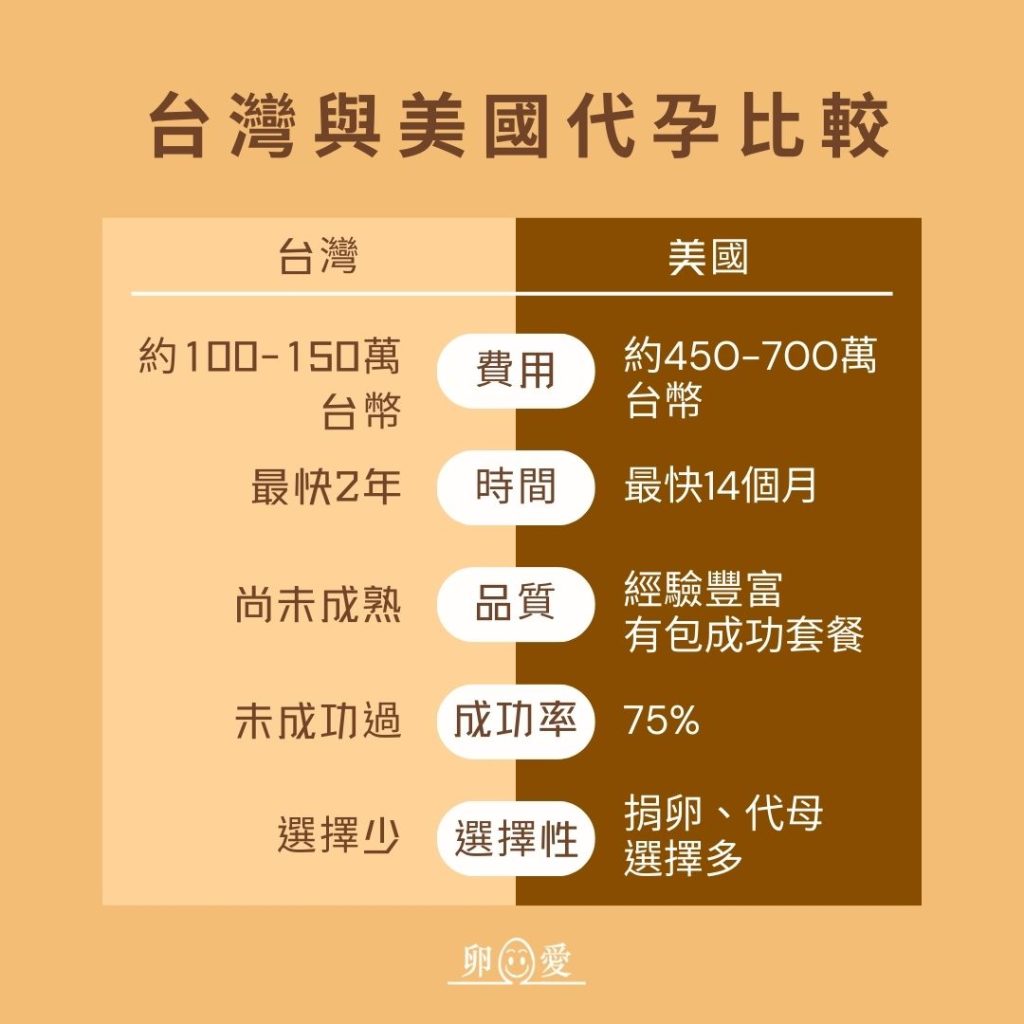
| Taiwan Surrogacy | and | U.S. Surrogacy |
平價 5*(10~12個月)+諮詢+產檢+生活費+營養費 Estimated NT$1,000,000–1,500,000 | Cost | High cost — includes living allowance, counseling, medical care, and insurance. Around US$150,000–200,000 (NT$4.5–7 million). |
| Fully supervised by the Ministry of Health and Welfare (MOHW). Procedures can be lengthy — as fast as 2 years, or 3–4+ years for complex cases. | Mature process | —can result in a baby within 14 months, depending on medical and legal timelines. |
| Still in the early legislative stage; limited real-world experience. Some uncertainty remains, as issues may be resolved through trial and error. | Over 30 years of established practice; a | well-developed | industry with experienced doctors and embryology labs. Many clinics even offer “success guarantee” packages.
| No confirmed domestic success cases yet; success rate not yet established. | Approximately 75% | success rate, depending on clinic and intended parents’ age. |
| Very limited options — few available egg donors and surrogates due to current legal restrictions. | Wide variety of choices — intended parents can | select | donors and surrogates based on genetics, education, and health profiles.
Conclusion
As Taiwan moves forward with the implementation of the new Assisted Reproduction Act amendment, it is expected to have a profound impact on the nation’s surrogacy landscape and the families who will benefit from it.
While challenges and adjustments will undoubtedly arise during the rollout phase, with joint efforts from the government, medical professionals, and society, surrogacy services in Taiwan are poised to evolve toward a fairer, safer, and more transparent future.
U.S Global Egg Donation — Your Trusted Partner on the Path to Parenthood
We understand how deeply many families long to experience the joy of having children, especially now, as Taiwan’s new surrogacy legalization proposal offers renewed hope.
We invite intended parents to learn about egg donation and surrogacy programs early, so that once the new law takes effect, you’ll be fully prepared to begin your fertility journey with confidence.
By understanding qualified donor options, procedures, and estimated costs, you can make informed decisions and avoid missing precious opportunities due to lack of information or preparation.
Contact us today to explore available donor profiles and receive personalized guidance.
Let Luan Love accompany you on this journey — embracing the coming legal reforms and building a happier future together.
Quick FAQ
1. What are the key points in the Ministry of Health and Welfare’s new Assisted Reproduction Act draft?
The draft introduces several major regulations, including:
Eligibility requirements for surrogates
Mandatory medical and psychological evaluations for both the surrogate and the intended parents
Legal notarization of all surrogacy contracts
The primary goal is to protect the legal rights and welfare of all three parties — the intended parents, the surrogate, and the child — while ensuring the surrogate receives fair compensation, nutritional support, and insurance coverage throughout the process.
2. What specific qualifications and evaluations are required for surrogates and intended parents?
The draft sets strict eligibility standards, requiring surrogates to meet specific health and psychological criteria.
Both the intended parents and surrogate must undergo dual evaluations — one medical (conducted by certified OB-GYN specialists) and one psychological (conducted by licensed psychologists).
Additionally, official notarization is required by the central authority to confirm legal validity and safeguard all participants’ rights.
3. What costs must intended parents cover?
According to the proposed legislation, intended parents are responsible for covering multiple surrogacy-related expenses, including:
Nutrition allowance
Counseling and psychological support fees
Legal notarization fees
Living expenses
Medical and maternity costs