


Today, we are providing a transparent breakdown of publicly available donor egg costs to help you better understand the actual expenses associated with egg donation (using donor eggs) in the United States. Having a clearer picture of these costs can help intended parents plan their family-building journey more effectively and reduce the risk of unexpected financial burdens.
From egg donor compensation, agency service fees, medical screening, in vitro fertilization (IVF) treatment, legal services, medications, travel and accommodation expenses to other potential cycle-related costs, it is important to understand which expenses are included and which may need to be paid separately before beginning the treatment process.
In this guide, Generation Family Network breaks down the major costs associated with using an egg donor in the US and explains the factors that can influence the overall price. We also highlight common fees intended parents should ask about when comparing egg donation programs, including options for families searching for qualified Asian and Chinese egg donors. With transparent information and professional support, Generation Family Network helps intended parents better understand their budget, avoid unexpected expenses, and make informed decisions as they move forward with their family-building journey.
Table of Contents

Navigating the Real Costs of Egg Donation
Choosing egg donation is an important step for many intended parents who are working toward building their families. While the medical process and donor selection often receive the most attention, understanding the real cost of egg donation in the US is equally important. Expenses can include donor compensation, agency services, medical screening, fertility clinic procedures, medications, legal services, insurance, travel, and other cycle-related costs.
At Generation Family Network, we believe intended parents should have a clear understanding of these potential expenses before beginning their journey. Knowing what is included in an egg donation program—and what may require an additional payment—can make financial planning easier and help families avoid unexpected costs.
The Emotional Preparation and the Financial Realities of IVF
Assisted reproductive treatment through in vitro fertilization (IVF) can be emotionally and financially demanding, particularly for intended parents who have already experienced multiple failed IVF cycles or unsuccessful fertility treatments. By the time a family begins considering donor eggs, they may have already invested significant time, energy, and financial resources in their efforts to achieve a successful pregnancy.
Therefore, when intended parents ask, “How much does it cost to use donor eggs in the United States?”, it is important to look beyond a single advertised price. The total cost may depend on factors such as egg donor compensation, fertility clinic medication and physician/procedure fees, required medical and genetic screening, legal agreements, travel arrangements, and whether fresh or frozen donor eggs are used.
Different egg donation agencies may also structure their fees differently. Some expenses may be included in the initial agency service package, while medical procedures, donor travel expenses, insurance, legal services, or medications may be charged separately. For this reason, intended parents should request a detailed breakdown of all anticipated donor egg costs before committing to an egg donation program.
Understanding these expenses from the beginning can help families compare different options more accurately and develop a more realistic budget for their entire family-building journey.
Why Financial Transparency Matters: Avoiding Hidden Fees and Surprise Bills
Financial transparency is especially important when comparing egg donation agencies in the United States. A program that initially appears more affordable may ultimately cost more if essential services are excluded from the quoted price.
Intended parents should clearly understand what is included in the agency service fee and proactively ask about any potential additional expenses. These costs may include egg donor compensation, psychological evaluation, genetic testing, medical screening, legal agreements, ovarian stimulation medications, monitoring appointments (in the donor’s home country or out of state), egg donor insurance, airfare, accommodation, transportation expenses, and other cycle-related costs.
This becomes particularly important for international families or intended parents exploring affordable Asian egg donor options in the United States. Travel requirements, donor location, compensation expectations, clinic coordination, and treatment schedules can all influence the final budget.
Generation Family Network focuses on helping intended parents understand the egg donation process and its associated expenses as clearly as possible. By reviewing potential costs early and explaining which services are included or separate, families can make informed decisions without relying solely on an attractive starting price.
Ultimately, transparency is not simply about finding the cheapest egg donation program. It is about understanding where your money is going, what services you are receiving, and what additional expenses could arise. A clear financial plan can reduce uncertainty and allow intended parents to focus more confidently on what matters most—their journey toward building a family.
🌟 Quick Fact
📊In egg donation, the advertised price may not represent the total cost of treatment. Expenses such as donor screening, medications, medical care, insurance, legal services, and travel may be handled separately depending on the program. The American Society for Reproductive Medicine (ASRM) emphasizes that fertility programs should clearly disclose financial terms and excluded costs so patients can make informed decisions and avoid unexpected expenses.
Further Reading: Financial Compensation of Oocyte Donors: An Ethics Committee Opinion

How Many IVF Cycles Should You Try Before Considering Egg Donation?
One of the most common questions intended parents ask is, “How much does a donor egg cost in USA?” There is no single price because the total depends on whether you choose a fresh or frozen donor egg program, the donor’s compensation, agency fees, fertility clinic charges, medications, legal services, monitoring, insurance, and travel.
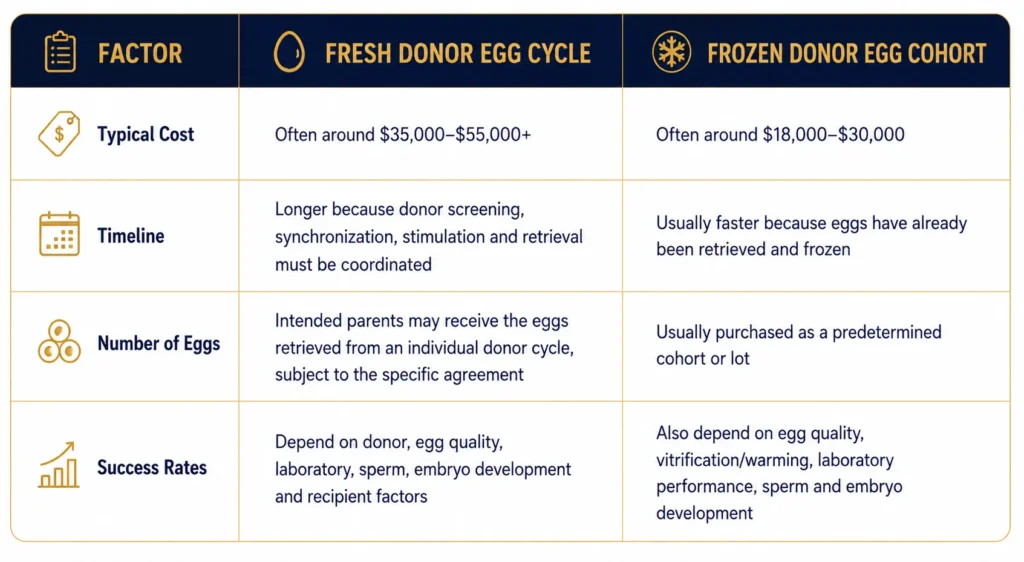
As a general planning range, a donor egg journey in the United States can cost approximately $18,000 to $50,000 or more. Frozen donor egg programs often fall toward the lower end, while a fresh donor cycle can become more expensive because it involves recruiting and coordinating an individual donor through screening, stimulation, monitoring, retrieval, and potentially travel.
For example, one published U.S. egg donation cost estimate lists a $13,000 program fee, donor compensation starting at $10,000, and a $400 escrow service fee, producing an estimated starting total of $23,400+ before medical expenses. The same estimate notes that donor travel and monitoring can add thousands of dollars when the selected donor does not live near the fertility clinic.
This is why intended parents should compare the total expected cost, rather than simply comparing an agency’s advertised starting fee.
Average Cost Ranges: Fresh vs. Frozen Donor Cycles ($18,000–$50,000+)
The cost difference between fresh and frozen donor eggs can be significant.
Fresh donor egg cycles commonly involve an individual donor undergoing ovarian stimulation specifically for the intended parents. Expenses can include agency coordination, donor compensation, medical and genetic screening, fertility medications, monitoring, egg retrieval, legal agreements, insurance, escrow management, and travel.
Current published estimates illustrate how quickly these costs can accumulate. One agency estimates total egg donation costs at approximately $32,000–$42,000, including agency fees, legal expenses, donor compensation and related costs, while medications, travel and monitoring can represent substantial portions of the budget. Another published estimate places fresh donor cycles around $35,000–$55,000+ when clinic and IVF-related expenses are included.
Frozen donor egg cycles, on the other hand, generally involve purchasing a cohort—or predetermined number—of previously retrieved and cryopreserved eggs from an egg bank. Because the donor has already completed stimulation and retrieval, intended parents typically do not have to pay for donor travel or coordinate an entire fresh retrieval cycle.
Published frozen donor egg packages can start around $17,900 for six mature eggs, although outside medical services are additional. Broader estimates put a complete frozen donor egg cycle at roughly $18,000–$30,000, depending heavily on the egg bank, fertility clinic, number of eggs, embryology services, medications, and optional testing.
For intended parents working with Generation Family Network, understanding these individual cost categories can make it easier to compare donors and programs based on the overall expected budget rather than the initial quoted price alone.
Fresh vs. Frozen Egg Cohorts: Speed, Cost, and Success Rates
Choosing between fresh and frozen donor eggs involves more than deciding which option costs less. Intended parents should consider availability, treatment timeline, number of eggs available, donor choice, clinic recommendations, and expected outcomes.

Generation Family Network Egg Donation Agency Fees Breakdown
Understanding an egg donation agency fees breakdown is one of the best ways for intended parents to prepare financially for an egg donor cycle in the United States. The total cost is not simply the donor’s compensation. A complete journey may involve agency coordination, donor screening, legal services, escrow management, medical expenses, insurance, monitoring, travel, and accommodation.
At Generation Family Network, the goal is to help intended parents understand the different expenses involved before moving forward. Actual costs can vary according to the selected donor, fertility clinic, donor location, medical requirements, and travel needs.
Agency & Matching Fees: What Coordination & Management Covers
The egg donor agency fee generally covers the professional coordination required to bring the intended parents, donor, fertility clinic, attorneys, and other parties together.
Depending on the program, agency and matching services may include donor recruitment and profile management, helping intended parents select a donor, coordinating donor availability, communicating with fertility clinics, arranging screening and appointments, assisting with legal and escrow coordination, and managing the donor’s schedule throughout the cycle.
Estimated Agency Fee: $8,000-$15,000
This coordination becomes particularly important when the donor and intended parents are in different cities, states, or countries. Generation Family Network works to keep each party informed while helping the cycle progress from donor selection through retrieval.
The $8,000-$15,000 agency fee should be distinguished from other expenses, such as donor compensation, fertility clinic charges, medical screening, medications, legal fees, meal allowances, and travel expenses.
Donor Compensation & Allowances: Base Pay, Meals and Stipends
Egg donor compensation is generally calculated separately from agency fees and medical expenses. The actual amount may vary depending on the individual donor and the terms agreed upon by both parties before the cycle begins.
For example, some publicly available egg donation programs in the United States indicate that compensation for first-time egg donors may start at approximately $8,000, although the actual amount can vary depending on the donor and the specific program.
In addition to donor compensation, egg donors may receive reasonable allowances or reimbursements for expenses directly related to the donation cycle. A typical budget may include a meal allowance of approximately $800–$1,400, as well as reimbursement for transportation, mileage, parking, and other approved expenses incurred while traveling to medical appointments or for the egg retrieval procedure.
Estimated Meal Allowance: $800–$1,400
It is also important to note that the American Society for Reproductive Medicine (ASRM) states that egg donor compensation should reflect the donor’s time, inconvenience, physical discomfort, and the overall demands of the donation process, rather than being based on the number or quality of eggs ultimately retrieved.
Medical & Psychological Screening: FDA Testing, Genetics and Evaluations.
Before officially beginning an egg donation cycle, egg donors are generally required to undergo a comprehensive screening process to determine whether they are suitable candidates for egg donation.
U.S. FDA regulations establish donor eligibility requirements, including screening and testing for certain relevant communicable diseases. In addition, ASRM guidelines recommend that egg donors undergo a medical history evaluation, genetic screening, and psychological assessment or counseling.
Depending on the fertility clinic and the individual donor’s circumstances, screening costs may include baseline follicle evaluation, hormone testing, infectious disease testing, urine drug screening, genetic carrier screening, reproductive genetic risk assessment, physical examination, ovarian reserve assessment, ultrasound examinations, psychological evaluation, and other tests required by the fertility clinic.
Estimated Medical & Screening Costs: $5,000
This estimated $5,000 medical cost primarily covers donor screening and related medical evaluations. Actual costs may vary depending on the fertility clinic and the specific tests required. Intended parents should carefully review these expenses, as medical and screening costs may be charged separately from egg donation agency fees.
Legal & Escrow Management: Attorney Contracts and Trust Accounts
Legal agreements are another important part of egg donation arrangements in the United States. Attorneys may be responsible for preparing, reviewing, and negotiating the agreements between the intended parents and the egg donor. ASRM notes that third-party reproductive arrangements may involve legal fees associated with drafting agreements and completing the necessary legal process.
Legal expenses may therefore include the intended parents’ attorney fees (approximately $1,500), the egg donor’s independent attorney fees (approximately $1,000), contract preparation and review, and other related legal coordination costs.
In addition, an escrow account may be used to hold and distribute the egg donor’s compensation and other approved cycle-related expenses. Based on publicly available pricing from some U.S. service providers, escrow account service fees may be approximately $500, although the actual amount will depend on the provider used.
Generation Family Network helps intended parents understand the financial responsibilities that need to be arranged throughout the egg donation process, helping ensure that applicable funds are managed and distributed in accordance with the relevant agreements.
Further Reading:Third Party Reproduction
Travel & Insurance: Airfare, Lodging, and Donor Complication Coverage
Travel can become one of the largest variable expenses in a fresh egg donor cycle, particularly when the selected donor does not live close to the intended parents’ fertility clinic.
A published U.S. donor cost example estimates:
Expense Estimated Cost
Travel Expenses $4,000-$7,000
Monitoring Deposit $1,500-$2,000
Estimated Travel + Monitoring Total $5,500-$9,000
The amounts above are provided for reference purposes only and do not represent standardized pricing across the United States. Actual costs may vary depending on factors such as the donor’s country and out-of-pocket medical expenses, fertility clinic, length of accommodation, and travel arrangements.
Travel expenses may include round-trip airfare, hotel accommodation, ground transportation, mileage, parking and other approved travel-related costs. A local donor may therefore have substantially lower travel expenses than someone who must fly to another state for retrieval.
Outside monitoring can also add to the budget. If a donor lives far from the fertility clinic, some blood tests and ultrasounds may be completed at a local monitoring facility before she travels to the primary clinic.
Finally, intended parents should determine how donor complication coverage or insurance is handled. ASRM recommends that programs disclose their policies regarding medical costs arising from complications associated with egg retrieval and explains that donors should understand who will bear those costs.

Spotting & Avoiding Common Hidden Fees in Egg Donation
When comparing the cost of egg donation in the US, the initial agency or donor fee may represent only part of the total financial commitment. Fertility clinic procedures, laboratory services, medications, monitoring, genetic testing, and embryo storage can all be billed separately.
At Generation Family Network, we encourage intended parents to look beyond the advertised starting price and request a detailed breakdown of both included and excluded services. Understanding these potential expenses before treatment begins can help prevent unexpected bills later in the cycle.
1. Unlisted Clinical Charges: ICSI, PGT-A Genetic Testing & Embryo Storage
Some of the easiest expenses to overlook are services performed by the fertility clinic or embryology laboratory rather than the egg donation agency.
ICSI
Intracytoplasmic Sperm Injection (ICSI) is a laboratory procedure in which a single sperm is injected directly into an egg to assist fertilization. If ICSI is recommended or required by the clinic, it may carry a separate laboratory charge rather than being included in the basic donor egg package.
Before treatment, intended parents should ask:
- Is fertilization included in the IVF laboratory fee?
- Is ICSI included or billed separately
- Under what circumstances will the clinic recommend ICSI?
PGT-A Genetic Testing
Preimplantation Genetic Testing for Aneuploidy (PGT-A) evaluates embryos for chromosome-number abnormalities before embryo transfer. PGT-A is an additional procedure and should not automatically be assumed to be included in an egg donation or IVF package.
Potential expenses can include embryo biopsy, genetic laboratory testing, and related laboratory services. Whether PGT-A is appropriate should be discussed with the treating fertility specialist based on the individual case rather than chosen based on cost alone.
Embryo Freezing and Storage
A donor cycle may produce embryos that are not transferred immediately. These embryos can potentially be cryopreserved for future use, creating additional expenses for embryo freezing and ongoing storage.
ASRM notes that fertility practices may charge professional fees associated with services such as embryo thawing, transfer, cycle coordination, and other laboratory-related procedures.
Intended parents should therefore ask whether their quoted package includes:
Embryo cryopreservation → first year of storage → annual storage renewal → future frozen embryo transfer
These expenses can become particularly important for families planning more than one child.
2. Embryo Transfer Medication Costs for the Intended Mother or Gestational Surrogate ($3,000–$6,000)
Medication costs are another important expense that intended parents should carefully confirm before finalizing their estimated budget for an egg donation treatment cycle.
When an embryo created using donor eggs is prepared for transfer, the person carrying the pregnancy—whether the intended mother or a gestational surrogate—may need medications to prepare and support the uterine lining and create an appropriate environment for embryo implantation and early development. The specific medications, dosages, and duration of treatment will depend on the protocol prescribed by the fertility specialist.
Depending on the fertility clinic, pharmacy, insurance coverage, treatment protocol, and whether additional medications are required, medication expenses for the embryo transfer recipient may add several thousand dollars to the overall fertility budget.
For budgeting purposes, some families may set aside approximately $3,000–$6,000 for medication expenses. However, this range should be considered a general budgeting estimate rather than a standardized price across the United States.
Published costs can vary considerably among fertility clinics, pharmacies, and programs. Therefore, intended parents should request a personalized pharmacy cost estimate before beginning treatment rather than assuming that all medication expenses are included in their IVF treatment package.
🌟 Quick Fact
📊Using Employer Fertility Benefits to Help Manage Donor Egg Costs
Many intended parents employed by U.S. technology companies or large multinational corporations, such as Google, Meta, and Amazon, may have access to employer-sponsored fertility and family-building benefits.
Generation Family Network supports benefits offered through platforms such as Carrot Fertility. Generation Family Network can provide itemized invoices and relevant supporting documentation to assist intended parents with submitting eligible expenses for Carrot Card payments or reimbursement, subject to the terms, eligibility requirements, and approval policies of their individual employer benefit plan.
Recipient Medication Costs ($3,000–$6,000)
Choosing an egg donor who lives outside the fertility clinic’s local area can create another significant expense: outside or local monitoring.
During ovarian stimulation, an egg donor generally requires multiple appointments for blood tests and ultrasounds. If she lives far from the intended parents’ fertility clinic, these appointments may need to be performed at another medical facility near her home.
The monitoring facility can charge separately for services such as:
- Ultrasound examinations
- Hormone blood tests
- Laboratory processing
- Appointment or facility fees
- Coordination and transmission of results to the primary fertility clinic
As discussed in the previous cost breakdown, a published U.S. donor program example estimates a monitoring deposit of approximately $1,500–$2,000 when outside monitoring is necessary.
When combined with approximately $4,000–$7,000 in potential donor travel expenses, selecting an out-of-state donor could create approximately $5,500–$9,000 in additional travel and monitoring costs before other medical expenses are considered.

Donor Insurance
Insurance is an important—and sometimes overlooked—part of the true cost of an egg donation cycle. Egg donors undergo ovarian stimulation, monitoring, anesthesia, and egg retrieval, all of which involve medical care and carry some risk of complications.
The key question for intended parents is therefore not simply, “Does the donor have health insurance?” but rather, “Who will pay if a medical complication occurs because of the donation?”
The American Society for Reproductive Medicine (ASRM) recommends that egg donation programs ensure the donor has appropriate medical insurance or that the program has a policy in place to cover donation-related medical expenses and complications. Understanding this coverage before beginning a cycle can help intended parents avoid unexpected costs and gain a clearer picture of the overall cost of egg donation in the US.
In addition to donor insurance, intended parents may have access to several payment and reimbursement options. Depending on eligibility, these may include employer fertility benefits, itemized invoices for reimbursement, and medical financing or installment payment plans. Reviewing insurance coverage and available payment options in advance can make the financial side of egg donation more transparent and help families plan their journey with greater confidence.
Does Health Insurance Cover Egg Donor Cycles
Not necessarily. A donor’s regular personal health insurance should not automatically be assumed to cover expenses arising from an egg donation cycle. Coverage depends on the individual insurance policy, exclusions, fertility benefits, and the circumstances surrounding the treatment.
This is why some egg donation arrangements use special donor complication insurance in addition to—or instead of relying solely on—the donor’s personal health plan. Such coverage is intended to address eligible medical complications associated with ovarian stimulation and egg retrieval.
ASRM specifically recommends that programs disclose their policies regarding coverage of medical costs if an egg donor experiences complications. Ideally, donors should have a mechanism in place to cover healthcare expenses resulting from their participation in the donation process.
Although egg donation is generally considered safe, it is not risk-free. ASRM reports that severe ovarian hyperstimulation syndrome (OHSS) has historically been estimated at approximately 1–2% per retrieval cycle, while serious acute complications such as pelvic infection, internal bleeding, or ovarian torsion are estimated at less than 0.5%.
Who pays for Donor Insurance?
Depending on the egg donation arrangement, the intended parents may be responsible for purchasing or funding donor complication insurance, which can cost an estimated $1,000, as part of the overall cycle expenses. The actual premium may vary depending on the insurance provider, policy limits, donor circumstances, and coverage period.
In other programs, donor complication coverage may already be incorporated into an agency, fertility clinic, or donor-cycle package. This is another reason intended parents should not assume that an advertised egg donor agency fee represents the complete cost of the cycle.
Before signing an agreement, intended parents should ask:
- Is donor complication insurance included in the quoted price?
- If not, should we budget approximately $1,000 for donor insurance?
- What medical complications are covered?
- When does the insurance coverage begin and end?
- What are the deductible and maximum coverage limits?
- Who is responsible for medical expenses that are excluded from the policy?
These questions are especially important because donor complication insurance policies can differ significantly in their coverage periods, exclusions, deductibles, and maximum benefits. Reviewing the policy details in advance can help intended parents better understand their financial responsibilities and avoid unexpected expenses during or after the egg donation cycle.
Who pays for Donor Insurance?
For intended parents who have access to employer-sponsored fertility benefits, certain egg donation expenses may be eligible for reimbursement through fertility benefit programs such as Carrot and Progyny. Coverage and eligibility can vary depending on the employer’s specific plan, benefit limits, and covered fertility services.
To support the reimbursement process, itemized invoices can be provided with a detailed breakdown of eligible egg donation and fertility-related expenses. These documents may help intended parents submit claims, verify costs, and maximize available fertility benefits for egg donation.
Before beginning an egg donor cycle, intended parents should review their employer’s fertility benefits and confirm which expenses are eligible for reimbursement. Understanding your available coverage in advance can help reduce out-of-pocket costs and make the overall cost of egg donation in the US easier to plan and manage.
Fertility Loan Patient Financing Provider
For intended parents who prefer to spread the cost of egg donation and fertility treatment over time, patient financing can provide an alternative to paying the entire expense upfront. Through third-party fertility financing provider CapexMD, intended parents can explore customized fertility loans and installment payment plans designed to make family-building expenses more manageable.
Depending on eligibility and financing terms, these options may allow qualified applicants to divide eligible fertility-related costs into more manageable monthly payments. This can help families plan their budgets while preparing for expenses associated with an egg donation cycle, IVF treatment, and other eligible fertility services.
Because financing approval, interest rates, repayment periods, and eligible expenses can vary, intended parents should carefully review the lender’s terms before applying. Understanding both fertility financing options and the total cost of egg donation in the US can help families develop a clearer financial plan and reduce the pressure of managing significant upfront expenses.

Why Choose Generation Family Network as Your Partner Agency?
Choosing an egg donation agency is about more than finding an available donor. Intended parents need a trusted partner that can help coordinate donor matching, screening, fertility clinic communication, legal arrangements, travel, insurance, and financial planning throughout what can be a complex fertility journey.
Generation Family Network (GFN) specializes in Asian egg donor matching and supports intended parents from the United States and internationally. Founded in 2019, GFN provides assistance with egg donation, IVF coordination, international arrangements, and related family-building services.
GFN has also established working relationships with several leading fertility centers and partner clinics, including HRC Fertility, AFMC, Reproductive Fertility Center (RFC), San Diego Fertility Center (SDFC), Gen 5 Fertility Center, as well as fertility service providers in the La Jolla area of San Diego.
Through these clinic partnerships, GFN can help facilitate and coordinate egg donor screening, medical appointments, IVF treatment schedules, and egg retrieval procedures more efficiently, while supporting communication among intended parents, egg donors, and fertility care teams throughout the process.
By combining an extensive donor-matching network with experienced case coordination and established fertility clinic relationships, GFN helps intended parents navigate each stage of the egg donation process with greater organization and transparency.
Transparent and Itemized Cost Information
Financial uncertainty can add unnecessary stress to fertility treatment. Agency fees, donor compensation, medications, monitoring, legal services, insurance, and travel may all contribute to the final cost of egg donation.
GFN states that it provides intended parents with an itemized cost estimate based on the matching country and treatment timeline, with costs disclosed before the agreement is signed.
This approach allows families to look beyond the headline agency fee and better understand where their budget is going.

Frequently Asked Questions
Q1: How much does one egg donor cycle cost on average in the US?
The cost of an egg donor cycle in the United States can vary significantly, but intended parents may encounter overall budgets of approximately $18,000 to $50,000+, depending on whether they use fresh or frozen donor eggs and which services are included.
A fresh donor cycle may include donor compensation, agency fees, medical and psychological screening, medications, legal services, escrow management, donor insurance, monitoring, travel, egg retrieval, fertilization, and other IVF laboratory expenses. Additional procedures such as ICSI, PGT-A, and embryo storage can increase the final cost.
Because agencies and fertility clinics structure their fees differently, intended parents should request an itemized estimate rather than relying only on the advertised starting price.
Q2: Why are Asian egg donors typically higher in cost?
Asian egg donors are not automatically more expensive, and ethnicity alone should not determine compensation. However, intended parents searching for a particular Asian background may encounter higher overall costs when there are fewer matching donors available or when the donor must travel to the intended parents’ fertility clinic.
Other factors—such as donor availability, prior donation experience, location, travel requirements, and individual program pricing—can also influence the final budget.
ASRM states that donor compensation should reflect the donor’s time, inconvenience, discomfort, and demands associated with donation, rather than the number or quality of eggs retrieved.
At Generation Family Network, intended parents searching for Asian egg donors should compare the complete cost of each option, including donor compensation, agency fees, travel, monitoring, and other cycle expenses—not simply the donor’s advertised compensation.
Q3: What do egg donation agency fees include?
An egg donation agency fee generally covers the professional services involved in recruiting, matching, and coordinating an egg donor cycle. Depending on the agency, this can include donor recruitment and profile management, matching assistance, communication with the donor and fertility clinic, appointment coordination, cycle management, and assistance coordinating legal, escrow, travel, and other third-party services.
Agency fees normally should be distinguished from donor compensation and third-party expenses such as fertility clinic charges, medications, legal fees, genetic testing, insurance, travel, and accommodation.
ASRM notes that third-party assisted reproduction can involve separate payments to donors, professional recruiters who bring the parties together, and attorneys who draft and negotiate agreements.
For this reason, intended parents should ask exactly what the agency fee includes and which services will be billed separately before signing an agreement.
Q4: Are agency fees refundable if a cycle gets canceled?
It depends on the agency, contract, and stage at which the cycle is canceled. There is no universal refund policy that applies to every U.S. egg donation agency.
Some agencies may allow part of the fee to be transferred to another donor, while others may offer a partial refund when cancellation occurs before medications begin. Once significant matching, coordination, screening, legal, or cycle-management services have already been performed, certain fees may become non-refundable.
For example, one U.S. egg donation agency states that if a cycle is canceled before the donor begins medication, its agency and donor-compensation fees may be transferred to another donor cycle; if the intended parents decline a replacement donor, its published policy provides a 50% agency-fee refund and a full donor-compensation refund. This is an example of one agency’s policy—not an industry-wide rule.
ASRM also recommends having clear written terms addressing payments when an egg donation cycle is stopped before retrieval.
Before paying, intended parents working with Generation Family Network or any egg donation program should review the cancellation policy carefully and confirm which fees are refundable, transferable, partially refundable, or non-refundable at each stage of the process.