

Introduction
During IVF, you may hear your doctor talk about embryos, blastocysts, embryo grades, and transfer days. Terms such as Day 3 embryo, Day 5 blastocyst, 4AA, or 3BB can be confusing, especially if this is your first IVF cycle.
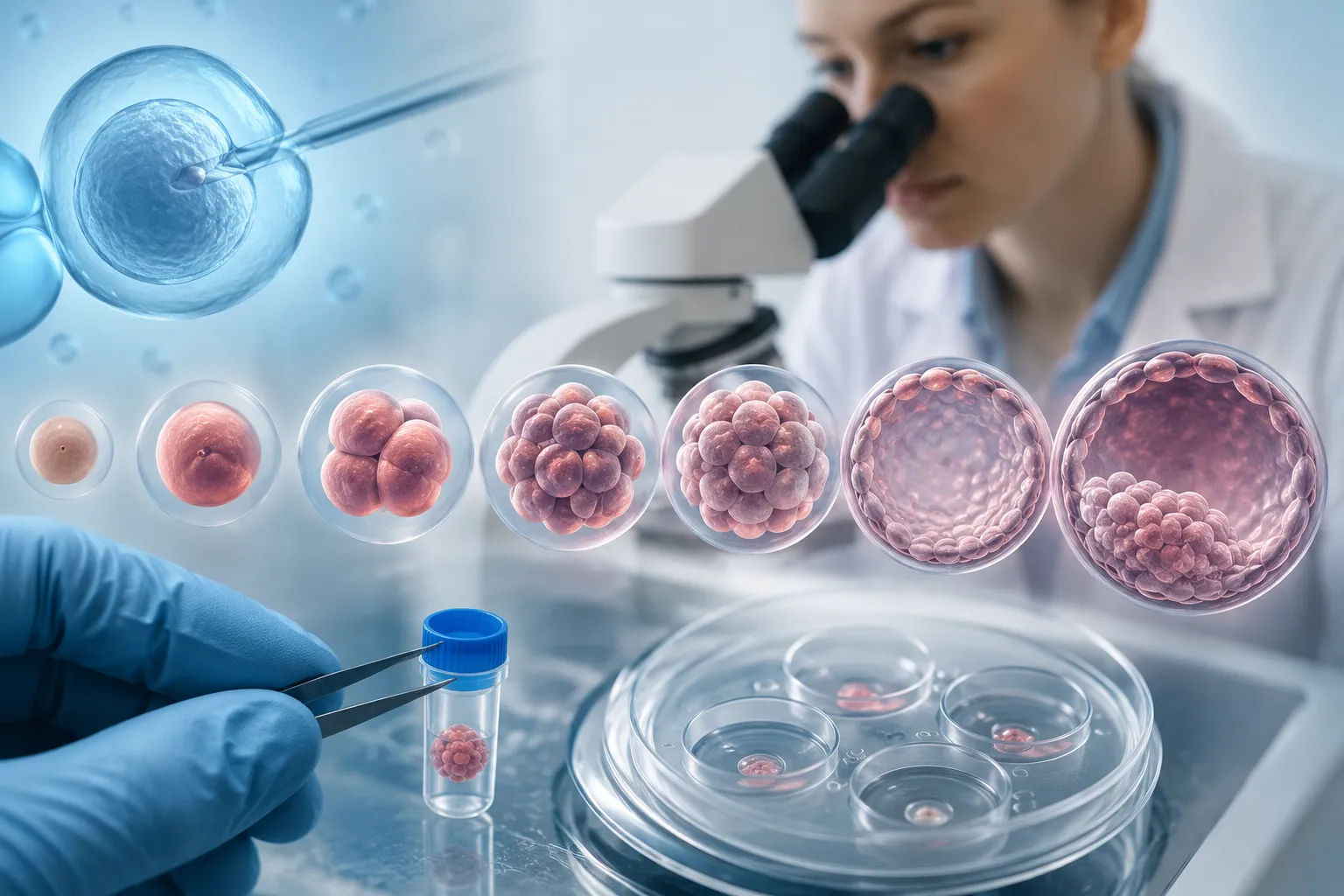
An embryo goes through several stages of development after an egg is fertilized. By Day 3, it usually reaches the cleavage stage, when it is made up of several cells. If it continues developing, it may reach the blastocyst stage around Day 5 or Day 6.
Doctors and embryologists look at how these embryos develop and grade them based on certain features. These grades can help the fertility team decide which embryos may be suitable for transfer or freezing. However, embryo grade is only one part of the decision.
In this guide, we explain Day 3 embryos vs. Day 5 blastocysts, how embryo and blastocyst grading works, what grades such as 4AA and 3BB mean, and what factors doctors consider when deciding which embryo and development stage to use for an IVF embryo transfer.
Table of Contents
Day 3 Embryo vs. Day 5 Blastocyst: What’s the Difference?
One of the most common questions during IVF is the difference between a Day 3 embryo and a Day 5 blastocyst. Both are embryos, but they are at different stages of development.
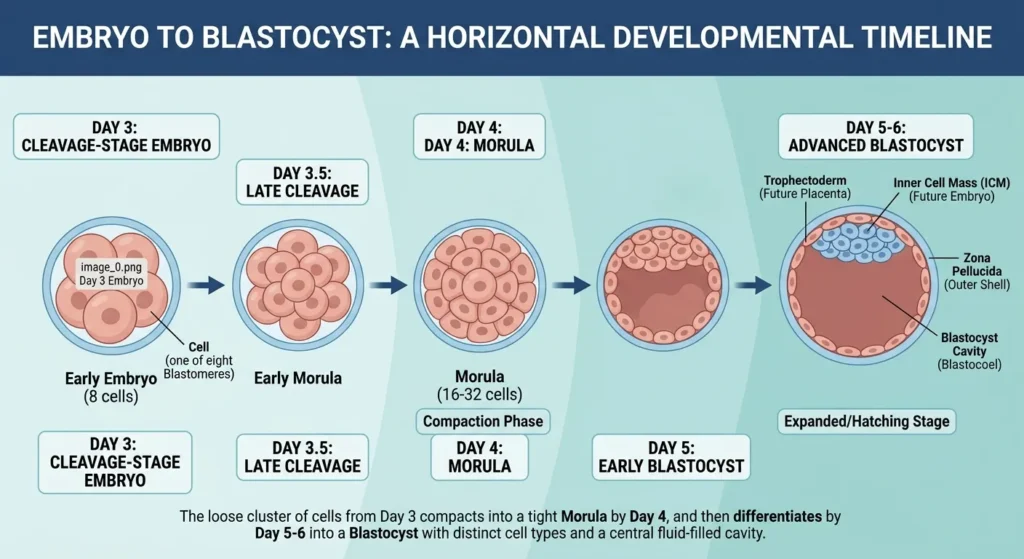
After fertilization, an embryo begins dividing and growing in the IVF laboratory. By Day 3, it is usually in the cleavage stage. If development continues, the embryo may reach the blastocyst stage around Day 5 or Day 6.
The main difference between a Day 3 embryo vs. Day 5 blastocyst is how far the embryo has developed before it is transferred or frozen. This difference can also affect how embryologists evaluate and select embryos for transfer.
What Is a Day 3 Embryo?
A Day 3 embryo is an embryo that has been developing for about three days after fertilization. At this point, it is known as a cleavage-stage embryo.
During the cleavage stage, the fertilized egg divides into more cells without greatly increasing in overall size. Embryologists examine the embryo’s cell number, cell symmetry, fragmentation, and other features to help evaluate its development.
Day 3 embryos may be transferred to the uterus, frozen for later use, or kept in the laboratory for further development into a blastocyst.
What Is a Day 5 Blastocyst?
A Day 5 blastocyst is an embryo that has continued developing for about five days after fertilization and has reached a more advanced stage.
Unlike a Day 3 embryo, a blastocyst has developed different groups of cells with specific roles. The inner cell mass (ICM) is the group of cells that can develop into the fetus, while the trophectoderm (TE) forms cells that contribute to the placenta.
The blastocyst also contains a fluid-filled space called the blastocoel.
Not every embryo will reach the blastocyst stage. Growing embryos until Day 5 or Day 6 gives embryologists more time to observe their development and can help with embryo selection. However, extended culture can also mean that some patients have fewer embryos available for transfer or freezing.
How an Embryo Grows From Day 1 to Day 5
Embryo development happens quickly during the first few days after fertilization:
Day 1 – Fertilization:
The laboratory checks whether the egg has fertilized normally. A normally fertilized egg is called a zygote.
Day 2 – Early Cell Division:
The embryo begins dividing into several cells.
Day 3 – Cleavage Stage:
The embryo continues dividing and is evaluated based on features such as cell number, symmetry, and fragmentation.
Day 4 – Morula Stage:
The cells become more tightly packed together. This stage is called the morula.
Day 5 – Blastocyst Stage:
The embryo may develop into a blastocyst, with an inner cell mass, trophectoderm, and fluid-filled cavity.
Some embryos develop more slowly and may not become blastocysts until Day 6 or later. Reaching the blastocyst stage later does not automatically mean an embryo cannot result in a successful pregnancy.
Understanding these stages helps explain why your IVF clinic may recommend a Day 3 embryo transfer in some situations and a Day 5 blastocyst transfer in others. The best choice depends on factors such as the number and development of your embryos, your treatment history, and your fertility clinic’s recommendations.
💡 Quick Fact
A Day 3 embryo is still in the early cleavage stage, while a Day 5 embryo has usually developed into a blastocyst with specialized cell groups. Reaching the blastocyst stage gives embryologists more information about how the embryo is developing and can help with embryo selection for transfer.
Related Video: Her Journey, My Dream
Further Reading: Blastocyst culture and transfer in clinically assisted reproduction: a committee opinion
Understanding Embryo and Blastocyst Grades
During IVF, embryologists use embryo grading to describe how an embryo looks and how it is developing in the laboratory. Day 3 embryos and Day 5 blastocysts are graded differently because they are at different stages of growth.
Embryo grades can help doctors decide which embryos may be suitable for embryo transfer or freezing. However, a grade is mainly an assessment of the embryo’s appearance and development—it cannot guarantee whether an embryo will implant or lead to a healthy pregnancy.
How Doctors Grade Day 3 Embryos
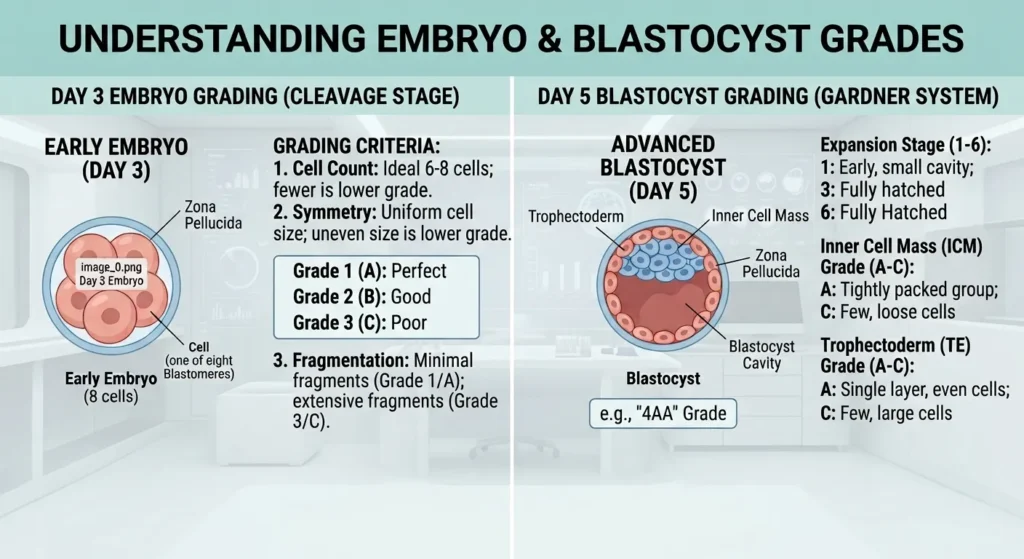
A Day 3 embryo is usually in the cleavage stage. At this point, embryologists look at several features under a microscope, including:
- Cell number: Around Day 3, an embryo is often expected to have about 8 cells.
- Cell size and symmetry: Embryologists look at whether the cells are similar in size and developing normally.
- Fragmentation: Small pieces of cellular material may appear between the embryo’s cells. Lower levels of fragmentation are generally considered more favorable.
- Multinucleation: Embryologists may also look for cells containing more than one nucleus.
According to international embryo-assessment guidance, an optimal Day 3 embryo has traditionally been described as having about 8 evenly sized cells with little fragmentation. Embryo grading systems can vary between IVF laboratories, so patients should ask their clinic how its specific grading system works.
How Doctors Grade Day 5 Blastocysts
By Day 5 or Day 6, an embryo may develop into a blastocyst. Blastocysts are commonly evaluated using a system based on three parts.
- Expansion number
The number describes how developed or expanded the blastocyst is:
1 – Early blastocyst
2 – Blastocyst
3 – Full blastocyst
4 – Expanded blastocyst
5 – Hatching blastocyst
6 – Hatched blastocyst
- Inner Cell Mass (ICM)
The first letter describes the inner cell mass, the group of cells that develops into the fetus.
A: Many tightly packed cells
B: Several more loosely grouped cells
C: Very few visible cells
- Trophectoderm (TE)
The second letter describes the trophectoderm, the outer layer of cells that contributes to structures including the placenta.
A: Many cells forming a strong, connected layer
B: A moderate number of more loosely arranged cells
C: Fewer cells with poorer layer formation
This combination creates familiar blastocyst grades such as 4AA, 4AB, 3BB, and 5AA.
Intended Parents Registration Link: Click Me
What Do Blastocyst Grades Like 4AA and 3BB Mean?
Once you understand the three parts of blastocyst grading, codes such as 4AA and 3BB become much easier to read.
4AA blastocyst
- 4 = Expanded blastocyst
- First A = High-quality inner cell mass
- Second A = High-quality trophectoderm
In simple terms, 4AA describes an expanded blastocyst with strong-looking inner cell mass and trophectoderm development.
3BB blastocyst
- 3 = Full blastocyst
- First B = Inner cell mass with several, more loosely grouped cells
- Second B = Trophectoderm with a moderate number of cells in a looser layer
A 3BB blastocyst therefore has reached the full blastocyst stage but has different morphological features from a 4AA blastocyst.
💡 Quick Fact
A higher blastocyst grade does not guarantee pregnancy. Blastocyst grading describes what an embryo looks like under the microscope. It is useful for ranking embryos, but embryo morphology is only one factor doctors consider when selecting an embryo for transfer.
Further Reading: Embryo Grading Scales
If you’re considering egg donation and have any questions about the process feel free to reach out to the【Generation Family Network】 professional team. We’re here to help you understand everything clearly and guide you through each step with confidence and care.
Day 3 vs. Day 5 Embryo Transfer: Pros and Cons
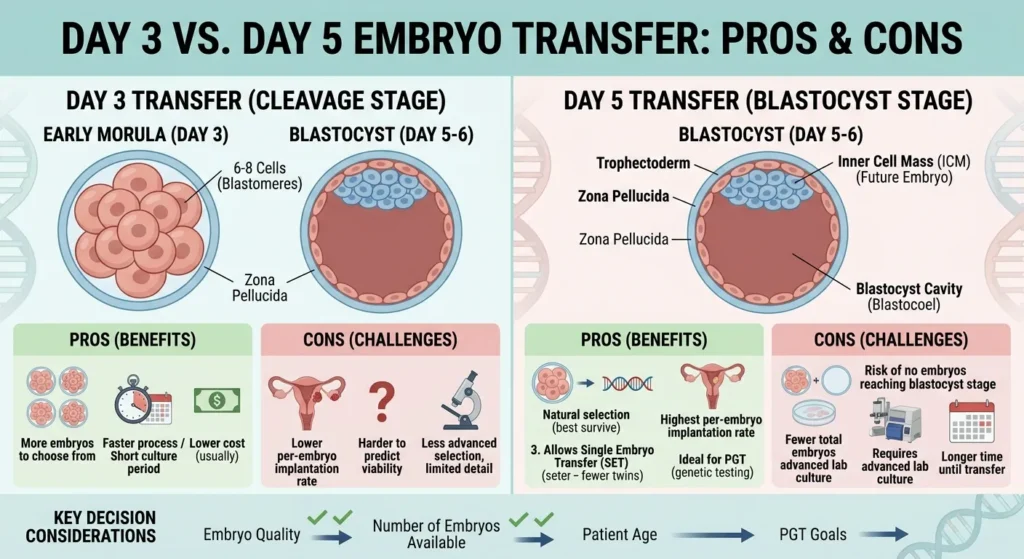
When choosing between a Day 3 vs. Day 5 embryo transfer, there is no single option that is best for every IVF patient. A Day 5 blastocyst transfer gives the embryo more time to develop in the lab, while a Day 3 embryo transfer places the embryo into the uterus earlier.
The best choice may depend on the number and quality of embryos, the patient’s age and IVF history, and how well embryos are developing in the laboratory.
Benefits of a Day 5 Blastocyst Transfer
A major benefit of a Day 5 blastocyst transfer is that embryologists have more time to watch how each embryo develops.
Embryos that continue growing from Day 3 to the blastocyst stage can provide the fertility team with more information for selecting an embryo for transfer. Research reviewed by the American Society for Reproductive Medicine (ASRM) has found higher implantation and live birth rates per fresh transfer with blastocyst-stage transfer in good-prognosis patients compared with cleavage-stage transfer. However, this advantage does not apply equally to every IVF patient.
Another benefit is timing. A Day 5 blastocyst is closer to the stage when an embryo would normally enter the uterus and prepare for implantation.
Blastocysts are also commonly used when preimplantation genetic testing (PGT) is planned because cells can be taken from the trophectoderm for testing.
Possible benefits include:
- More time to observe embryo development
- Better embryo selection before transfer
- Higher implantation potential per transferred embryo in some patients
- Suitable for PGT
- Can support single embryo transfer to lower the risk of twins or higher-order multiple pregnancies
Benefits of a Day 3 Embryo Transfer
A Day 3 embryo transfer may be considered when only a small number of embryos are available or when there is concern that extended laboratory culture may leave no embryo available for transfer.
Instead of waiting until Day 5, the embryo is transferred to the uterus during the cleavage stage.
One potential advantage is that patients do not have to wait for their embryos to reach the blastocyst stage before transfer. This may be important because not every Day 3 embryo will continue developing into a usable Day 5 or Day 6 blastocyst.
However, transferring earlier does not prove that the uterus can “rescue” an embryo that would otherwise stop developing in the laboratory. The decision should be based on the individual IVF cycle and the clinic’s laboratory experience.
Possible benefits include:
- Earlier embryo transfer
- May be considered when only a few embryos are available
- Reduces the chance of having no transfer because all embryos stopped developing before Day 5
- May be considered after reviewing previous embryo development and IVF history
What Happens If an Embryo Does Not Reach Day 5?
Not every embryo that looks healthy on Day 3 will become a Day 5 blastocyst. Some embryos may slow down or stop developing during extended culture.
If an embryo stops developing and does not meet the clinic’s criteria for transfer or freezing, it may not be used.
This is one of the main risks of waiting for a Day 5 blastocyst transfer. ASRM has reported that extended blastocyst culture can increase the chance of having no embryo available for transfer, particularly in unselected patients.
However, an embryo that has not become a blastocyst by Day 5 has not necessarily stopped developing. Some embryos develop more slowly and may reach a usable blastocyst stage on Day 6 or Day 7, depending on the clinic’s protocols.
Further Reading: ASRM — Blastocyst Culture and Transfer in Clinically Assisted Reproduction
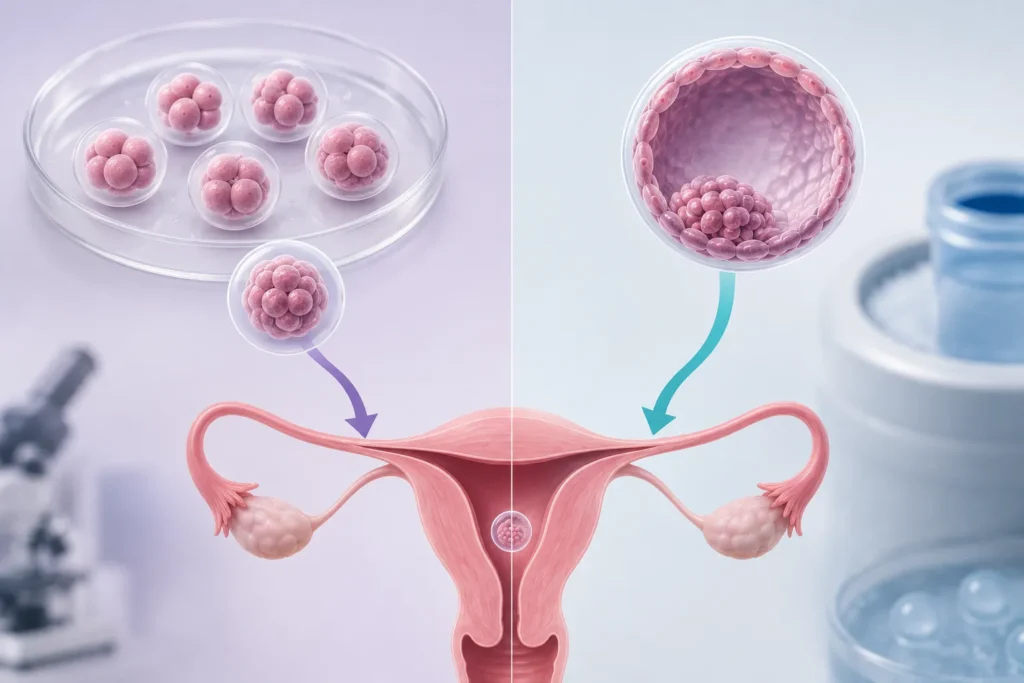
Which Embryo Stage Should You Transfer?
Choosing between a Day 3 embryo transfer and a Day 5 blastocyst transfer depends on your individual IVF cycle. Doctors may consider your age, number of embryos, embryo quality, previous IVF results, and how well your embryos are developing in the laboratory.
For some patients, waiting until Day 5 can help identify embryos that continue developing into blastocysts. For others, especially those with only a few embryos, a Day 3 embryo transfer may be considered.
There is no single embryo stage that is best for everyone. Your fertility doctor and embryologist should recommend a transfer plan based on your specific situation.
When a Day 5 Blastocyst Transfer May Be Recommended A Day 5
blastocyst transfer may be recommended when several good-quality embryos are developing normally and there is a reasonable chance that some will reach the blastocyst stage.
Waiting until Day 5 gives embryologists more time to observe embryo development. This can help them select an embryo that has continued growing well.
Research from the American Society for Reproductive Medicine (ASRM) supports blastocyst transfer particularly for good-prognosis IVF patients. Studies reviewed by ASRM have found higher implantation and live birth rates per transfer with blastocyst-stage embryos compared with cleavage-stage embryos in this group.
A Day 5 blastocyst transfer may be considered when:
- Several good-quality embryos are available
- Embryos are developing normally
- Your doctor wants more time to select an embryo for transfer
- Preimplantation genetic testing (PGT) is planned
- A single embryo transfer is recommended
When a Day 3 Embryo Transfer May Be Recommended
A Day 3 embryo transfer may be considered when fewer embryos are available or when there is concern that waiting until Day 5 could result in no embryo being available for transfer.
During a Day 3 transfer, the embryo is placed into the uterus while it is still in the cleavage stage.
ASRM notes that it is still difficult to predict with certainty which Day 3 embryos will successfully develop into viable blastocysts. Extended culture also has a higher risk of a cancelled transfer in unselected IVF patients because some embryos may stop developing before Day 5.
A Day 3 embryo transfer may be considered when:
- Only a small number of embryos are available
- Previous embryos have had difficulty reaching the blastocyst stage
- Your doctor is concerned about having no embryo available for transfer on Day 5
- Your previous IVF history suggests an earlier transfer may be reasonable
What If You Only Have a Few Embryos?
Having only a few embryos does not automatically mean you should transfer on Day 3.
Your fertility team will look at the number of embryos, their development and quality, your age, previous IVF cycles, and the experience of the IVF laboratory.
If only one or two embryos are developing, your doctor may discuss whether it is better to transfer earlier or continue growing them to the blastocyst stage.
One concern with extended culture is that an embryo that looks promising on Day 3 may stop developing before Day 5. ASRM reports that extended blastocyst culture can increase the chance of having no embryo available for transfer, especially in patients who are not considered good-prognosis candidates.
However, transferring an embryo on Day 3 also does not guarantee that it would have continued developing after transfer. This is why the decision should be personalized rather than based only on the number of embryos.
💡 Quick Fact
The highest-looking embryo grade is not a guarantee of pregnancy. Embryo grading helps fertility teams compare embryos, but implantation depends on several embryo and patient-related factors.
Frequently Ask Questions
Q1: How Many of My Embryos Reached Day 3 and Day 5?
A1:
Ask your embryologist how many fertilized eggs developed into Day 3 embryos and how many continued growing into Day 5 or Day 6 blastocysts.
Not every fertilized egg will reach the blastocyst stage. Some embryos naturally stop developing along the way. Knowing how your embryos developed can help you better understand your IVF results and your available options for transfer or freezing.
Q2: What Happens If My Embryos Stop Growing?
A2:
Sometimes an embryo stops dividing or developing before reaching the blastocyst stage. This is known as embryo developmental arrest.
There are many possible reasons for this, including chromosome problems and other biological factors that affect normal embryo development.
Laboratory conditions and individual patient factors may also play a role.
If an embryo stops developing and does not meet the clinic’s criteria for transfer or freezing, it generally will not be used. Your fertility team can explain what happened during your cycle and whether a different approach should be considered in a future IVF cycle.
Q3: Should I Choose a Fresh or Frozen Embryo Transfer?
A3:
A fresh embryo transfer usually takes place within the same IVF cycle in which the eggs are retrieved. A frozen embryo transfer (FET) takes place later, after an embryo has been frozen and then thawed for transfer.
Neither approach is automatically better for every patient.
A frozen embryo transfer may be recommended when PGT is performed, when there is a risk of ovarian hyperstimulation syndrome (OHSS), or when your doctor believes transferring in a later cycle may be more appropriate.
Your doctor can recommend fresh vs. frozen embryo transfer based on your health, hormone levels, embryo development, uterine lining, and treatment plan.
Q3: Which Embryo Has the Best Chance of Implantation?
A3:
Embryologists consider several factors when choosing an embryo for transfer. These can include the embryo’s development stage, blastocyst grade, development speed, and genetic testing results when PGT has been performed.
For a blastocyst, embryologists may look at its expansion as well as the appearance of the inner cell mass (ICM) and trophectoderm (TE).
A higher morphological grade may be associated with better implantation potential, but embryo grading cannot guarantee implantation or pregnancy. Lower-grade embryos can still result in healthy births.
Your fertility team should consider embryo quality together with factors such as age, medical history, genetic testing results, and previous IVF outcomes when recommending which embryo to transfer.

Why Partner With Generation Family Network?
Choosing an egg donation agency is an important part of the family-building journey. At Generation Family Network (GFN), intended parents receive coordinated support throughout donor matching, medical screening, financial management, legal arrangements, insurance coordination, and fertility treatment planning.
By working with experienced third-party professionals and fertility-industry partners, GFN aims to provide intended parents with a more organized, transparent, and supported egg donation journey from donor selection through treatment.
Accessing a Diverse Asian Egg Donor Database
Generation Family Network’s Asian egg donor database allows intended parents to explore donors from a variety of Asian backgrounds and review characteristics that may be important to their search.
Depending on the individual donor profile and available information, intended parents may be able to consider factors such as:
- Ethnic and cultural background
- Age, height, and physical characteristics
- Educational background and degree level
- University, major, and professional interests
- Personal and family medical history
- Genetic screening information, when available
- Personality, hobbies, talents, and interests
- Previous egg donation experience, when applicable
- Current location and willingness to travel
- Donor availability and compensation expectations
For families searching for a high-education Asian egg donor, GFN can also help identify profiles that more closely match specific academic preferences, including donors with bachelor’s, master’s, doctoral, or professional-degree backgrounds.
Because donor availability changes, intended parents with highly specific requirements—such as ethnicity, education, height, appearance, and location—may benefit from discussing which criteria are essential and where they are comfortable being flexible.
Personalized Donor Matching Based on Intended-Parent Preferences
Every intended parent’s search is different. Instead of expecting families to navigate donor profiles without guidance, Generation Family Network can help narrow potential matches according to the characteristics that matter most to them.
The matching process may begin by identifying must-have requirements and preferred characteristics. For example, intended parents might prioritize medical and genetic suitability first, followed by Chinese or another Asian heritage, physical resemblance, educational background, donor experience, location, availability, and budget.
For families searching for highly specific profiles—such as Ivy League Chinese egg donors or donors with advanced academic backgrounds—personalized matching can help identify potentially suitable candidates without making academic achievement the sole basis for selection.
Once a potential donor has been identified, GFN can also help facilitate communication and coordination among the intended parents, donor, fertility clinic, and other professionals involved in the egg donation journey.
The goal is to make the search for an Asian egg donor more organized, transparent, and personalized while helping intended parents find a donor whose overall profile aligns with their family-building priorities.
ASRM-Aligned Screening Standards
Generation Family Network supports donor screening processes aligned with professional recommendations from the American Society for Reproductive Medicine (ASRM) and the requirements of the treating fertility clinic.
Depending on the donor and clinic, evaluation may include medical and family history, infectious-disease screening, reproductive assessment, psychological evaluation, and genetic carrier screening for egg donors. Final medical eligibility and testing requirements are determined by qualified fertility professionals.
Financial Security — SeedTrust Escrow
GFN works with SeedTrust to provide independent third-party escrow services. Funds are securely managed and disbursed according to the applicable agreement and established milestones.
This structured approach provides intended parents with greater financial transparency, security, and peace of mind throughout their egg donation journey.
Legal Protection — Law Offices of Lei, APC
GFN works with Law Offices of Lei, APC to support the legal aspects of egg donation arrangements.
Legal agreements can establish important terms regarding donor compensation, rights and responsibilities, confidentiality, medical procedures, and expectations between the parties, helping intended parents and donors proceed with greater clarity and legal protection.
Donor Protection — New Life Agency
The health and safety of the egg donor remain important throughout the donation process. GFN works with New Life Agency for insurance solutions that may provide coverage for eligible complications associated with an egg donation cycle.
Specific benefits, exclusions, and coverage depend on the applicable insurance policy.
Flexible Financing Options — CapexMD
GFN has partnered with CapexMD to provide eligible intended parents with access to fertility financing options.
Financing can help families manage qualifying expenses associated with egg donation, IVF, and fertility treatment, making the financial side of the family-building journey more manageable. Financing remains subject to CapexMD’s eligibility requirements, approval, rates, and terms.
If you’re considering egg donation and have any questions about the process feel free to reach out to the【Generation Family Network】 professional team. We’re here to help you understand everything clearly and guide you through each step with confidence and care.