


Introduction
Genetic health is an important consideration when building a family through egg donation. Genetic carrier screening for egg donors can help identify inherited genetic risks before IVF, while PGT-A testing for donor eggs evaluates embryos for chromosomal abnormalities before transfer. For intended parents researching PGT-A testing donor eggs success rates and options for preventing hereditary diseases through egg donation, understanding how these genetic screening tools differ—and how they may work together—can help support more informed decisions about donor selection, embryo testing, and fertility treatment.
Table of Contents
Prioritizing Genetic Health in Assisted Reproduction
For intended parents considering egg donation, choosing the right donor involves more than reviewing appearance, education, personality, and family background. Genetic health is also an important part of the donor selection and IVF process. Advances in reproductive genetics now allow fertility specialists to identify certain inherited risks before treatment and evaluate embryos for chromosomal abnormalities before embryo transfer.
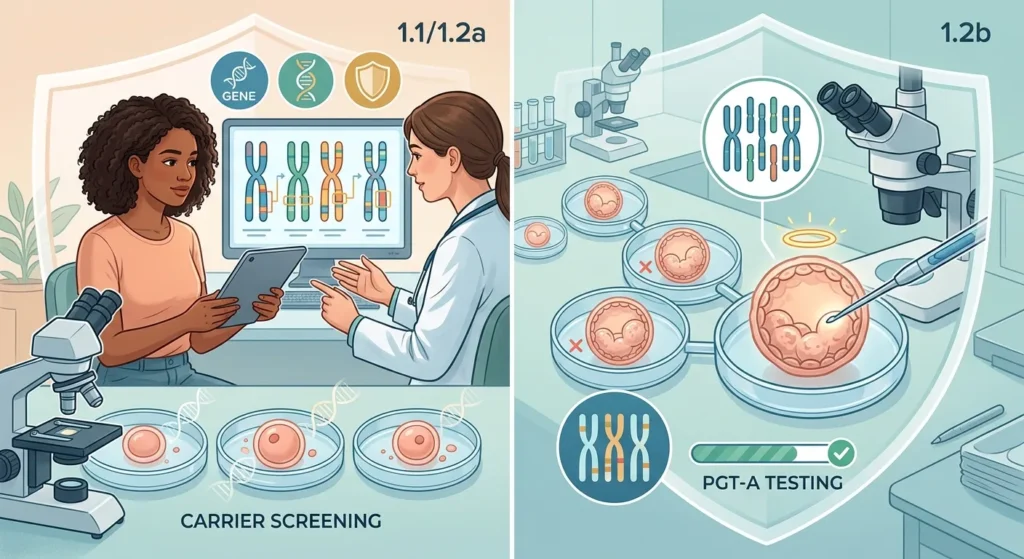
Two commonly discussed tools are genetic carrier screening for egg donors and PGT-A testing for embryos created with donor eggs. Although both involve genetics, they serve very different purposes. Carrier screening looks for specific inherited genetic conditions that a healthy donor may carry, while PGT-A evaluates the number of chromosomes in an embryo.
Understanding these differences can help intended parents make more informed decisions about donor selection, embryo testing, and preventing hereditary diseases in egg donation where possible. However, no genetic test can eliminate every genetic or pregnancy-related risk.
Why Genetic Screening Matters in Egg Donation
Egg donors are generally carefully evaluated before being medically approved for a donation cycle. While a donor may be young, healthy, and have no known personal or family history of genetic disease, she can still be a carrier of an inherited genetic condition without showing any symptoms.
This is why genetic carrier screening for egg donors can be an important part of the screening process.
Carrier screening can identify variants associated with certain inherited disorders, including autosomal recessive and X-linked conditions. If an egg donor is found to be a carrier, this does not automatically mean she is unsuitable to donate. Instead, the result can help the medical team determine whether additional testing of the sperm provider is appropriate.
For example, if both the egg donor and sperm provider are carriers of variants associated with the same autosomal recessive condition, their embryos may have an increased chance of being affected. In such situations, intended parents can discuss the results with their fertility specialist or genetic counselor before proceeding.
For families focused on preventing hereditary diseases through egg donation, genetic screening can therefore provide valuable information before a donor match is finalized. Depending on the results, options may include selecting a genetically compatible donor, obtaining genetic counseling, or considering additional embryo testing when medically appropriate.
Importantly, carrier screening does not guarantee a child free from genetic disease. Screening panels test for specific conditions and cannot identify every possible genetic variant or future health issue.
The Dual Layer of Protection: Carrier Screening vs. PGT-A
One common misconception is that carrier screening and PGT-A provide the same information. They do not. Instead, they evaluate different types of genetic risk at different stages of the IVF journey.
Genetic carrier screening for egg donors is performed on the donor, typically before the donation cycle. Its purpose is to identify whether she carries certain gene variants associated with inherited conditions. When appropriate, her results can be compared with those of the sperm provider to assess reproductive risk.
PGT-A (Preimplantation Genetic Testing for Aneuploidy), on the other hand, is performed on embryos after fertilization and development to the blastocyst stage. A small sample of cells is biopsied and analyzed to determine whether the embryo has the expected number of chromosomes. PGT-A primarily screens for aneuploidy, meaning extra or missing chromosomes.
💡 Quick Fact
According to the American Society for Reproductive Medicine (ASRM), egg donors should receive genetic carrier screening for conditions including cystic fibrosis, spinal muscular atrophy (SMA), and thalassemia/hemoglobinopathies. ASRM also recommends considering broader pan-ethnic expanded carrier screening because inherited recessive conditions can occur across ethnic groups.
For PGT-A with donor eggs, the evidence is more nuanced: ASRM’s 2024 review found that studies have not demonstrated a consistent improvement in live-birth rates from routinely adding PGT-A to donor-oocyte cycles. This is important when discussing the PGT-A testing donor eggs success rate with intended parents.
Related Video: Genetic Testing in High Risk Groups of Donors
Further Reading: ASRM – Gamete and Embryo Donation Guidance (2024)

Understanding Genetic Carrier Screening for Egg Donors
Genetic carrier screening for egg donors is an important part of evaluating potential inherited genetic risks before an egg donation cycle begins. A donor can be healthy, have no symptoms, and have no obvious family history of genetic disease while still carrying a genetic variant associated with an inherited condition.
Carrier screening helps fertility specialists and intended parents identify these risks before fertilization. According to the American Society for Reproductive Medicine (ASRM), all oocyte and sperm donors should be screened for carrier status for cystic fibrosis, spinal muscular atrophy (SMA), and thalassemia/hemoglobinopathies, while additional expanded carrier screening may also be appropriate. ASRM currently recommends a pan-ethnic expanded approach over relying solely on ethnicity-based panels.
Importantly, being identified as a carrier does not necessarily mean that an egg donor cannot donate. For many autosomal recessive conditions, the sperm provider’s genetic results become particularly important in determining the reproductive risk.
What Does Genetic Carrier Screening Test For?
Carrier screening primarily looks for gene variants associated with autosomal recessive and X-linked genetic conditions.
With an autosomal recessive condition, an affected child generally inherits a disease-causing variant in the same gene from both genetic parents. If both the egg donor and sperm provider are carriers for the same autosomal recessive condition, each pregnancy generally has a 25% chance of being affected, a 50% chance of the child being a carrier, and a 25% chance of inheriting neither familial variant.
This is why finding a carrier variant in an egg donor is not automatically a reason to exclude her. ASRM states that donors who are heterozygous carriers of autosomal recessive conditions that do not pose health risks to the carrier do not necessarily need to be excluded. Instead, the result should be evaluated alongside the sperm provider’s genetic screening.
X-linked conditions work differently. Because the relevant genes are located on the X chromosome, reproductive risks depend on the specific condition and the sex chromosomes inherited by the embryo. ASRM generally recommends excluding oocyte donors who carry X-linked conditions, although it recognizes possible exceptions for certain conditions.
For intended parents focused on preventing hereditary diseases in egg donation, carrier screening therefore provides valuable information about genetic compatibility before proceeding with a donor.
The Donor Screening Workflow: Expanded Panels vs. Targeted Testing
There are two major approaches to genetic carrier screening: targeted carrier screening and expanded carrier screening (ECS).
Targeted genetic testing focuses on specific conditions based on factors such as a known family history or other identified genetic risk. For example, if a donor has a family history suggestive of a particular hereditary disorder, genetic counseling and testing for that specific condition may be recommended.
Expanded carrier screening, by comparison, evaluates many genetic conditions using a single sample. The exact number and types of conditions included vary between laboratories and screening panels.
For egg donation specifically, ASRM recommends pan-ethnic expanded carrier screening over ethnicity-based panels, noting that self-reported ethnicity has limitations, populations are increasingly multiethnic, and rare recessive conditions can occur across ethnic groups.
A typical donor genetic screening process may therefore involve:
Medical and family history → Genetic counseling/risk assessment → Carrier screening → Review of results → Comparison with sperm provider → Additional testing when indicated → Medical clearance
ASRM also recommends obtaining a detailed three-generation family history from donors when possible. If the history suggests a potential hereditary condition, assessment by a qualified genetics professional and additional testing may be appropriate.
One important consideration is that not every expanded carrier screening panel tests for exactly the same conditions. Ideally, ASRM recommends that the egg and sperm sources be screened for the same conditions. If different laboratories or panels are used, a qualified professional should review the results to determine whether additional testing is necessary.
Intended Parents Registration Link: Click Me
Managing Donor–Recipient Genetic Matching and Carrier Risk
Finding that an egg donor is a carrier does not automatically end a potential match. Instead, the next step is usually to determine whether the sperm provider carries a clinically significant variant associated with the same condition.
ACOG recommends that when one reproductive genetic source is identified as a carrier for a particular condition, the other reproductive partner should be offered appropriate screening so that the reproductive risk can be assessed.
For example, imagine that an egg donor is identified as a carrier for an autosomal recessive condition.
If the sperm provider tests negative for the relevant condition, the risk of having an affected child is typically substantially reduced, although genetic testing cannot reduce the risk to zero. This remaining possibility is known as residual risk.
If both genetic sources are carriers for the same autosomal recessive condition, the intended parents should receive genetic counseling to understand the potential risk and available reproductive options. Depending on the specific condition and medical circumstances, those options may include selecting another egg donor or considering condition-specific preimplantation genetic testing such as PGT-M.
This matching process is one of the most important reasons to conduct genetic carrier screening for egg donors before IVF treatment. Rather than simply labeling donors as “positive” or “negative,” genetic screening allows intended parents and their medical team to evaluate whether the donor and sperm provider are genetically compatible for the conditions tested.
If you’re considering egg donation and have any questions about the process feel free to reach out to the【Generation Family Network】 professional team. We’re here to help you understand everything clearly and guide you through each step with confidence and care.
PGT-A Testing for Donor Eggs: Success Rates & Chromosomal Accuracy
For intended parents using donor eggs, Preimplantation Genetic Testing for Aneuploidy (PGT-A) can provide additional information about the chromosomal status of embryos before transfer. PGT-A screens embryos for aneuploidy, meaning an abnormal number of chromosomes, and can help embryologists identify embryos classified as euploid, aneuploid, or, in some cases, mosaic.
However, the relationship between PGT-A testing, donor eggs, and success rates requires careful interpretation. Because egg donors are generally young and medically screened, embryos created from donor eggs already tend to have relatively high euploidy rates. Current evidence does not demonstrate that routinely performing PGT-A on all donor-egg embryos improves live-birth rates. The American Society for Reproductive Medicine (ASRM) states that the overall evidence argues against the routine use of PGT-A in donor-oocyte cycles.
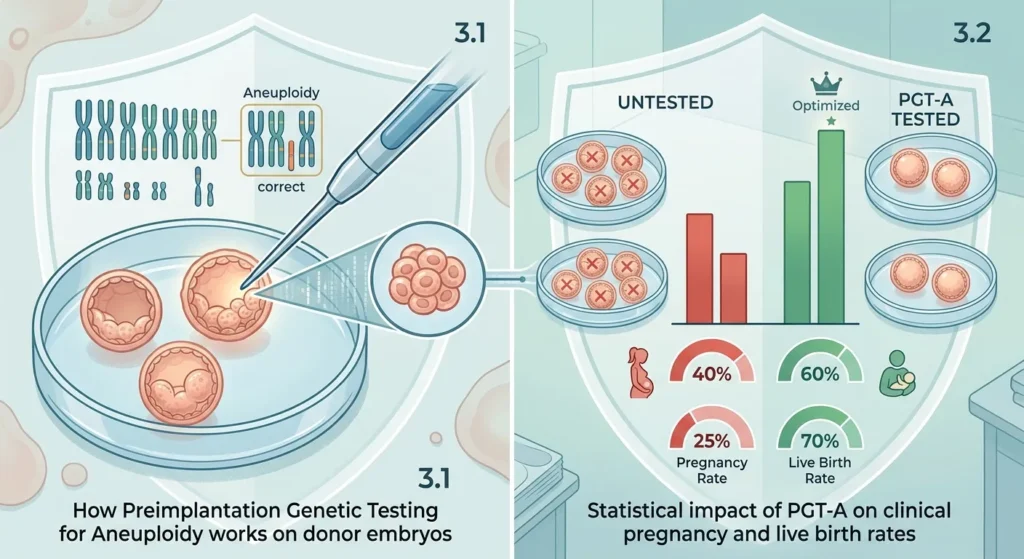
How Preimplantation Genetic Testing for Aneuploidy Works on Donor Embryos
PGT-A takes place after donor eggs have been retrieved and fertilized with sperm through IVF. Rather than testing the egg itself, PGT-A analyzes cells from the resulting embryo.
The process generally follows this sequence:
Donor egg retrieval → Fertilization → Embryo development → Blastocyst → Trophectoderm biopsy → PGT-A analysis → Embryo freezing → Results → Embryo selection → Transfer
Once an embryo develops to the blastocyst stage, usually around day 5–7 of development, several cells are carefully removed from the trophectoderm—the portion of the blastocyst that contributes primarily to the placenta. The embryo is typically vitrified while the biopsied cells are sent to a genetic laboratory.
Modern PGT-A platforms assess chromosome copy number across the embryo’s chromosomes. Results may classify an embryo as:
- Euploid: the tested cells show the expected chromosome number.
- Aneuploid: the tested cells show one or more chromosome-number abnormalities.
- Mosaic: the sample contains a mixture of cells with different chromosome findings.
This information can help physicians prioritize embryos for transfer, but PGT-A is a screening test rather than a guarantee of chromosomal or genetic health. A small sample of trophectoderm cells is being analyzed rather than every cell of the embryo, and technical and biological limitations—including mosaicism—need to be considered.
PGT-A also should not be confused with genetic carrier screening or PGT-M. PGT-A primarily evaluates chromosome number; it does not screen embryos for every hereditary disease.
Statistical Impact of PGT-A on Clinical Pregnancy and Live-Birth Rates
When intended parents search for the PGT-A testing donor eggs success rate, it can be tempting to assume that selecting a chromosomally screened embryo automatically increases the chance of pregnancy or live birth. Research does not support such a simple conclusion.
One donor-oocyte study cited by ASRM compared PGT-A cycles with controls and reported ongoing/live-birth rates of 64.4% with PGT-A versus 54% without PGT-A. Despite the numerical difference, it was not statistically significant, and the study included relatively few cycles.
A larger paired study involving vitrified donor eggs found:
Outcome | PGT-A | No PGT-A |
Live birth after first embryo transfer | 53.8% | 55.8% |
Live birth per transfer across the egg lot | 48.4% | 47.2% |
Median euploidy rate | 75% | — |
Neither live-birth comparison was statistically significant. The researchers concluded that PGT-A did not improve the chance of live birth in these donor-oocyte recipient cycles.
An even larger analysis examined 18,562 donor-oocyte IVF cycles—11,348 using fresh donor eggs and 7,214 using frozen-thawed donor eggs. Among fresh donor-oocyte cycles with blastocysts available, PGT-A was associated with a first-transfer live-birth rate of 46.9% compared with 53.2% without PGT-A, while cumulative live-birth rates were 58.4% versus 66.6%, respectively. For frozen-thawed donor eggs, the apparent difference in live birth (48.3% vs. 40.5%) was not statistically significant after adjustment for other factors.
Preventing Hereditary Diseases Through Egg Donation
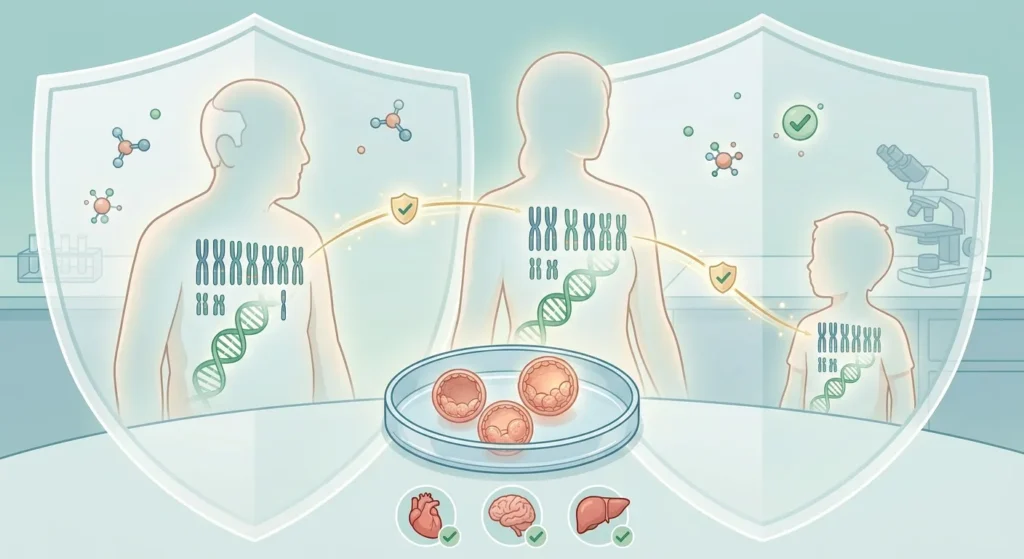
For intended parents concerned about inherited genetic conditions, egg donation can provide opportunities to reduce the risk of transmitting certain hereditary diseases. However, the process involves more than simply selecting a healthy donor. Genetic carrier screening, family-history assessment, genetic counseling, and—when medically appropriate—preimplantation genetic testing can work together to identify and manage specific reproductive risks.
Importantly, no approach can guarantee a child without genetic or medical conditions. The goal of preventing hereditary diseases through egg donation is to identify known risks and give intended parents and their medical team more information for making informed reproductive decisions.
Stopping Single-Gene Disorders With PGT-M vs. Carrier Screening
Genetic carrier screening for egg donors and Preimplantation Genetic Testing for Monogenic Conditions (PGT-M) both address inherited disease risk, but they are used at different stages and answer different questions.
Carrier screening is generally performed before embryo creation. It evaluates whether the egg donor or sperm provider carries pathogenic or likely pathogenic variants associated with particular inherited conditions.
For autosomal recessive disorders, the greatest concern generally arises when both genetic contributors carry disease-causing variants in the same gene. In that situation, each pregnancy may have a 25% chance of being affected, depending on the specific variants and inheritance pattern. The American College of Obstetricians and Gynecologists (ACOG) recommends offering screening to the reproductive partner when one individual is identified as a carrier so that reproductive risk can be assessed.
If a donor is found to be a carrier, this does not necessarily mean she must be excluded. ASRM guidance notes that individuals who are heterozygous carriers of autosomal recessive conditions without health risks to carriers do not necessarily need to be excluded as donors. Genetic counseling and appropriate screening of the other genetic contributor become particularly important.
PGT-M serves a different purpose. It is designed to test embryos for a specific single-gene condition when a particular genetic risk has already been identified. After IVF creates embryos, cells from suitable blastocysts can be biopsied and analyzed for the familial variant or condition for which the PGT-M test was developed.
This distinction is important:
| Carrier Screening | PGT-M |
Who/what is tested? | Egg donor and/or sperm provider | IVF embryos |
When? | Usually before IVF | After embryos are created |
Main purpose | Identify carrier status and reproductive risk | Determine which embryos are predicted to be affected, unaffected, or carriers for a specific condition |
Examples | CFTR-related cystic fibrosis, SMA and hemoglobinopathies | A known familial single-gene disorder |
Does it test all genetic diseases? | No | No |
Same as PGT-A? | No | No |
ASRM describes PGT-M as a technology available for many inherited single-gene conditions but emphasizes that it is not appropriate or necessary for every patient and should involve individualized counseling regarding its benefits, limitations, and alternatives.
For example, if an intended parent carries a serious autosomal dominant condition, choosing an egg donor without that variant does not remove the genetic risk coming from the intended parent’s sperm. In appropriate circumstances, PGT-M may therefore be considered to identify embryos predicted not to have inherited that particular familial variant.
Conversely, if carrier screening shows that an egg donor carries an autosomal recessive condition but the sperm provider does not carry a relevant pathogenic variant in the same gene, PGT-M may not be indicated solely because the donor is a carrier. A genetics professional can assess the specific results and residual risk.
Safeguarding Future Generations: Long-Term Genetic Health Benefits
One potential benefit of genetic carrier screening for egg donors is that it allows inherited risks to be evaluated before a pregnancy is established.
Imagine that both an egg donor and sperm provider carry pathogenic variants associated with the same autosomal recessive disorder. Without knowing their carrier status, the increased reproductive risk might not become apparent until pregnancy, newborn screening, or the birth of an affected child.
Preconception screening changes the timing of that information.
Carrier screening → Genetic compatibility assessment → Genetic counseling → Reproductive options → Embryo testing when indicated
This can give intended parents more reproductive options. Depending on the condition, inheritance pattern, and medical advice, they may decide to select a different donor, proceed after assessing residual risk, or consider IVF with PGT-M.
The implications can extend beyond one pregnancy. When a pathogenic variant is identified, that information may clarify genetic risks relevant to genetically related family members and future offspring. Genetic counseling can help families understand what the result means—and, equally importantly, what it does not mean.
There are also significant limitations. A donor who receives a negative result on an expanded carrier screening panel is not “genetically risk-free.” Screening cannot detect every disease-causing variant, and not every hereditary disorder is included on every panel. ACOG specifically notes that carrier screening cannot completely eliminate residual risk.
Likewise, PGT-M does not guarantee the birth of a healthy child. It targets the particular genetic condition for which the test was developed rather than every possible genetic abnormality or future health problem. ASRM also notes that prenatal testing should be discussed because prenatal diagnosis can provide greater diagnostic accuracy for the condition being evaluated after PGT-M.
For this reason, preventing hereditary diseases through egg donation is best understood as risk reduction and informed reproductive planning, rather than complete prevention of all genetic disease.
By combining a carefully reviewed family history, genetic carrier screening for egg donors, compatible screening of the sperm provider, professional genetic counseling, and PGT-M when clinically appropriate, intended parents can build a more informed strategy for protecting the genetic health of their future family.
Further Reading: ASRM — Indications and Management of PGT-M
Combining Genetic Screening and PGT-A: A Step-by-Step Clinical Roadmap
For intended parents using donor eggs, genetic testing does not happen at just one point in the IVF journey. A comprehensive approach may begin with genetic carrier screening for egg donors, continue with genetic compatibility assessment of the sperm provider, and, when clinically appropriate, include PGT-A testing of donor-egg embryos before embryo transfer.
Each step answers a different question. Carrier screening evaluates the risk of certain inherited genetic conditions, while PGT-A evaluates whether the tested cells from an embryo have the expected number of chromosomes.
Understanding how these steps fit together can help intended parents make informed decisions while balancing medical considerations, IVF success expectations, cost, treatment time, and peace of mind.
From Donor Selection to Euploid Embryo Transfer
The genetic screening process ideally begins before an egg donor is medically cleared and before embryos are created.
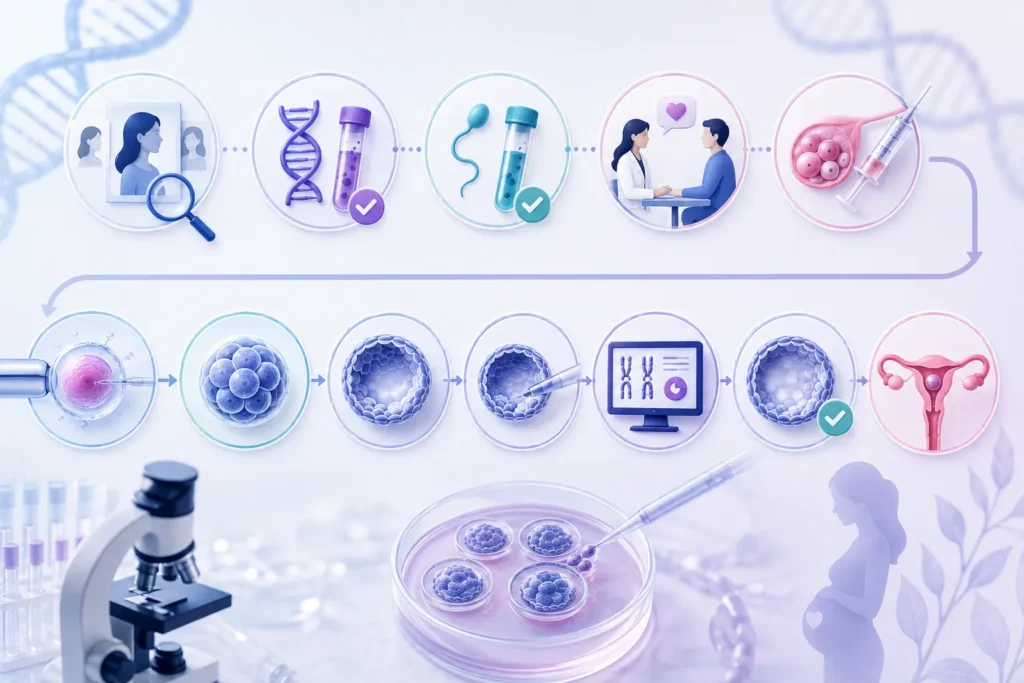
A typical clinical roadmap may look like this:
Egg Donor Selection → Medical & Family History → Genetic Carrier Screening → Sperm Provider Compatibility Screening → Genetic Counseling if Needed → Donor Stimulation & Egg Retrieval → Fertilization → Blastocyst Development → PGT-A (if chosen) → Embryo Results → Euploid Embryo Selection → Frozen Embryo Transfer
Step 1: Selecting and Reviewing the Egg Donor
Intended parents often begin by considering characteristics such as ethnicity, physical features, education, personality, medical history, and previous donation outcomes.
Genetic health should also be part of this evaluation. A donor’s personal and family medical history can help identify possible inherited risks. ASRM guidance recommends obtaining a detailed three-generation family history when possible as part of donor evaluation. ASRM — Gamete and Embryo Donation Guidance
Step 2: Genetic Carrier Screening for Egg Donors
The next stage is genetic carrier screening for egg donors.
Carrier screening can identify whether a healthy donor carries variants associated with certain autosomal recessive or X-linked conditions. The exact conditions tested depend on the laboratory and screening panel used.
A positive carrier result does not necessarily mean that a donor is unhealthy or unsuitable. For many autosomal recessive conditions, what matters is whether the sperm provider also carries a relevant disease-causing variant associated with the same condition.
This makes genetic compatibility assessment an important part of donor matching.
Step 3: Screening the Sperm Provider
If the donor is identified as a carrier, the sperm provider may need testing for the same condition. Ideally, both genetic sources are evaluated using compatible screening panels. If different laboratories or panels were used, the fertility clinic or genetics professional may need to determine whether additional testing is appropriate.
If both are carriers for the same autosomal recessive condition, intended parents should receive genetic counseling to understand the specific reproductive risk and available options.
Those options may include choosing another donor or, when appropriate, considering PGT-M for a known single-gene disorder.
This step is particularly important for families interested in preventing hereditary diseases through egg donation.
Step 4: Ovarian Stimulation and Egg Retrieval
After medical and genetic clearance, the donor undergoes controlled ovarian stimulation under the supervision of the fertility clinic. Once the follicles reach the appropriate stage, the eggs are retrieved and assessed by the embryology laboratory. Mature eggs can then be fertilized with the selected sperm, usually through conventional IVF or intracytoplasmic sperm injection (ICSI), depending on the clinical plan.
Step 5: Embryo Development
After fertilization, embryos are cultured in the laboratory. Embryos that continue developing may reach the blastocyst stage around days 5–7. If the intended parents and their physician have chosen PGT-A, suitable blastocysts can then undergo biopsy.
Step 6: PGT-A Testing of Donor-Egg Embryos
During PGT-A testing for donor eggs, several cells are biopsied from the embryo’s trophectoderm, the tissue that primarily contributes to the placenta.
The embryo is generally vitrified while the sample is analyzed.
PGT-A results may classify an embryo as euploid, aneuploid, or mosaic, depending on the chromosomal findings and the laboratory’s reporting criteria.
A euploid embryo is one whose tested sample shows the expected chromosome copy number.
However, PGT-A remains a screening test. It does not guarantee that an embryo will implant, result in a live birth, or produce a child without genetic or medical conditions.
Step 7: Selecting an Embryo for Transfer
If one or more embryos are reported as euploid, the fertility specialist can use the PGT-A results together with embryo morphology and other clinical factors when deciding which embryo to transfer. The embryo is then thawed and transferred into the prepared uterus.
It is important to remember that even after transferring a euploid embryo, successful implantation and live birth are not guaranteed. Uterine factors, embryo biology, sperm factors, laboratory procedures, and other clinical variables can influence treatment outcomes.
Evaluating Cost, Time, and Peace of Mind
For intended parents, deciding whether to add PGT-A to a donor-egg IVF cycle involves more than asking, “Does PGT-A improve donor egg success rates?”
The decision should balance potential clinical value against additional cost, treatment time, embryo availability, and personal priorities.
Cost of Additional Genetic Testing
Genetic carrier screening for egg donors may already be incorporated into a donor’s screening process or may require additional testing depending on the clinic, agency, donor, and laboratory.
PGT-A involves separate costs that can include embryo biopsy, genetic laboratory testing, embryo vitrification and storage, and frozen embryo transfer-related expenses. The total cost varies substantially between fertility clinics and genetic laboratories.
For intended parents with several embryos, PGT-A may provide additional information for embryo selection. However, because donor eggs generally come from younger individuals and have a lower age-related risk of aneuploidy than eggs from older patients, the potential benefit should be discussed carefully with the treating physician.
How PGT-A Can Affect the IVF Timeline
PGT-A can also add steps to the treatment process.
Instead of proceeding directly from blastocyst development to transfer, embryos are generally biopsied and frozen while genetic testing is completed.
The process becomes:
IVF → Blastocyst → Biopsy → Freeze → Genetic Analysis → Results → Frozen Embryo Transfer
The exact turnaround time depends on the clinic and genetics laboratory.
For intended parents prioritizing the fastest possible transfer, this additional step may be an important consideration. For others, receiving information about embryo chromosome status before transfer may be worth the additional time.
Does PGT-A Improve Donor-Egg IVF Success Rates?
This is one of the most important SEO questions surrounding PGT-A testing donor eggs success rate, but the answer requires nuance. Research has not established that routinely performing PGT-A on donor-egg embryos improves the cumulative live-birth rate for every intended parent.
ASRM’s review of the available evidence concluded that the totality of evidence argues against routine PGT-A in donor-oocyte cycles. Donor eggs typically originate from younger women, meaning the baseline rate of embryo aneuploidy is already lower than in many older-age IVF populations. ASRM — Evidence on PGT-A and Donor Oocytes
Therefore, PGT-A should not be marketed or understood as a guaranteed method for increasing IVF success.
Its potential value may instead lie in providing additional chromosome information that can help guide embryo-selection decisions in appropriate cases.
The Value of Peace of Mind
For some intended parents, genetic testing provides an additional sense of preparedness. Knowing that the egg donor and sperm provider have undergone appropriate carrier screening can help clarify risks for certain inherited diseases. When PGT-A is selected, intended parents also receive additional information about the chromosome status of tested embryos.
However, peace of mind should be based on realistic expectations.
Neither genetic carrier screening nor PGT-A can guarantee:
- A genetically “perfect” embryo
- Successful implantation
- An uncomplicated pregnancy
- A live birth
- A child without genetic or medical conditions

Frequently Ask Questions
Q1: Do All Egg Donors Undergo Genetic Carrier Screening?
A1:
Genetic screening requirements can vary depending on the fertility clinic, egg donor program, and individual medical circumstances. However, genetic carrier screening for egg donors is an important part of modern donor evaluation.
ASRM recommends that egg and sperm donors be screened for carrier status for conditions including cystic fibrosis, spinal muscular atrophy (SMA), and thalassemia/hemoglobinopathies, with expanded pan-ethnic carrier screening also recommended over ethnicity-based screening alone. The exact number of conditions tested can vary by laboratory and screening panel.
Q2: Is PGT-A Necessary if the Egg Donor Is Young and Healthy?
A2:
Not necessarily. PGT-A testing for donor eggs is not routinely required simply because donor eggs are being used.
Egg donors are typically young, which is important because embryo aneuploidy is strongly associated with egg age. Current evidence has not demonstrated that routinely adding PGT-A to donor-oocyte cycles consistently improves live-birth outcomes.
ASRM’s 2024 committee opinion concluded that available evidence argues against the routine use of PGT-A in donor-egg cycles. However, there may be individual circumstances in which a fertility specialist recommends discussing PGT-A. ASRM — PGT-A Committee Opinion
For intended parents researching the PGT-A testing donor eggs success rate, it is important to evaluate live-birth outcomes—not simply whether PGT-A can identify euploid embryos. The decision should be individualized with the fertility specialist.
Further Reading: ASRM-PGT-A Committee Opinion
Q3: What Is the Difference Between Genetic Carrier Screening and PGT-A?
A3:
The key difference is who is tested and what the test is designed to identify.
Genetic carrier screening for egg donors tests the donor for variants associated with specific inherited genetic conditions. When necessary, the sperm provider can also be screened to evaluate genetic compatibility and the risk of passing certain hereditary diseases to a child.
PGT-A (Preimplantation Genetic Testing for Aneuploidy) tests cells biopsied from embryos created through IVF. It primarily evaluates whether the tested embryo sample has the expected number of chromosomes.
In simple terms:
Carrier Screening → Inherited single-gene disease risk
PGT-A → Embryo chromosome-number screening
PGT-A does not replace carrier screening and does not test for every hereditary disease. When there is a known risk of a particular single-gene condition, PGT-M may be considered instead.

Why Partner With Generation Family Network?
Choosing an egg donation agency is an important part of the family-building journey. At Generation Family Network (GFN), intended parents receive coordinated support throughout donor matching, medical screening, financial management, legal arrangements, insurance coordination, and fertility treatment planning.
By working with experienced third-party professionals and fertility-industry partners, GFN aims to provide intended parents with a more organized, transparent, and supported egg donation journey from donor selection through treatment.
Accessing a Diverse Asian Egg Donor Database
Generation Family Network’s Asian egg donor database allows intended parents to explore donors from a variety of Asian backgrounds and review characteristics that may be important to their search.
Depending on the individual donor profile and available information, intended parents may be able to consider factors such as:
- Ethnic and cultural background
- Age, height, and physical characteristics
- Educational background and degree level
- University, major, and professional interests
- Personal and family medical history
- Genetic screening information, when available
- Personality, hobbies, talents, and interests
- Previous egg donation experience, when applicable
- Current location and willingness to travel
- Donor availability and compensation expectations
For families searching for a high-education Asian egg donor, GFN can also help identify profiles that more closely match specific academic preferences, including donors with bachelor’s, master’s, doctoral, or professional-degree backgrounds.
Because donor availability changes, intended parents with highly specific requirements—such as ethnicity, education, height, appearance, and location—may benefit from discussing which criteria are essential and where they are comfortable being flexible.
Personalized Donor Matching Based on Intended-Parent Preferences
Every intended parent’s search is different. Instead of expecting families to navigate donor profiles without guidance, Generation Family Network can help narrow potential matches according to the characteristics that matter most to them.
The matching process may begin by identifying must-have requirements and preferred characteristics. For example, intended parents might prioritize medical and genetic suitability first, followed by Chinese or another Asian heritage, physical resemblance, educational background, donor experience, location, availability, and budget.
For families searching for highly specific profiles—such as Ivy League Chinese egg donors or donors with advanced academic backgrounds—personalized matching can help identify potentially suitable candidates without making academic achievement the sole basis for selection.
Once a potential donor has been identified, GFN can also help facilitate communication and coordination among the intended parents, donor, fertility clinic, and other professionals involved in the egg donation journey.
The goal is to make the search for an Asian egg donor more organized, transparent, and personalized while helping intended parents find a donor whose overall profile aligns with their family-building priorities.
ASRM-Aligned Screening Standards
Generation Family Network supports donor screening processes aligned with professional recommendations from the American Society for Reproductive Medicine (ASRM) and the requirements of the treating fertility clinic.
Depending on the donor and clinic, evaluation may include medical and family history, infectious-disease screening, reproductive assessment, psychological evaluation, and genetic carrier screening for egg donors. Final medical eligibility and testing requirements are determined by qualified fertility professionals.
Financial Security — SeedTrust Escrow
GFN works with SeedTrust to provide independent third-party escrow services. Funds are securely managed and disbursed according to the applicable agreement and established milestones.
This structured approach provides intended parents with greater financial transparency, security, and peace of mind throughout their egg donation journey.
Legal Protection — Law Offices of Lei, APC
GFN works with Law Offices of Lei, APC to support the legal aspects of egg donation arrangements.
Legal agreements can establish important terms regarding donor compensation, rights and responsibilities, confidentiality, medical procedures, and expectations between the parties, helping intended parents and donors proceed with greater clarity and legal protection.
Donor Protection — New Life Agency
The health and safety of the egg donor remain important throughout the donation process. GFN works with New Life Agency for insurance solutions that may provide coverage for eligible complications associated with an egg donation cycle.
Specific benefits, exclusions, and coverage depend on the applicable insurance policy.
Flexible Financing Options — CapexMD
GFN has partnered with CapexMD to provide eligible intended parents with access to fertility financing options.
Financing can help families manage qualifying expenses associated with egg donation, IVF, and fertility treatment, making the financial side of the family-building journey more manageable. Financing remains subject to CapexMD’s eligibility requirements, approval, rates, and terms.
If you’re considering egg donation and have any questions about the process feel free to reach out to the【Generation Family Network】 professional team. We’re here to help you understand everything clearly and guide you through each step with confidence and care.