




Introduction
For many Chinese intended parents (IPs), building a family through egg donation involves much more than finding the right donor. One of the biggest challenges is understanding the legal landscape across different countries. Regulations surrounding donor anonymity, parental rights, embryo creation, compensation, and cross-border fertility treatment vary significantly, making it essential to choose a destination that aligns with your family-building goals. Whether you are considering the United States, Taiwan, or Thailand, understanding each country’s legal framework can help you avoid costly mistakes and unnecessary delays.
The legal egg donation USA for Chinese intended parents has become one of the most searched topics in international fertility because the United States offers one of the world’s most established and legally structured egg donation systems. Many Chinese families choose California due to its strong reproductive laws, experienced fertility clinics, and legal protections for intended parents, including support for diverse family structures. In particular, understanding LGBT egg donor laws California is increasingly important for same-sex couples and single intended parents seeking clear parental rights and inclusive fertility care.
At the same time, many prospective parents compare affordability alongside legal protections. Questions surrounding IVF egg donation cost Taiwan vs US continue to grow as families evaluate whether lower treatment costs outweigh legal limitations, donor availability, and embryo transportation restrictions. While Taiwan remains an attractive option due to its advanced medical technology and relatively affordable IVF services, its reproductive laws differ substantially from those in the United States. Thailand, meanwhile, has emerged as another fertility destination, but its regulations governing foreign intended parents have evolved considerably in recent years.
This comprehensive guide compares egg donation laws in the USA, Taiwan, and Thailand specifically from the perspective of Chinese intended parents. We’ll explore legal eligibility, donor anonymity, parental rights, LGBT accessibility, treatment costs, and the practical advantages and disadvantages of each destination. By the end, you’ll have a clearer understanding of which country best fits your fertility journey, legal needs, and long-term family-building goals.
Table of Contents
Why Chinese Intended Parents Choose International Egg Donation
For many Chinese intended parents, international egg donation offers opportunities that may be difficult to access domestically. Factors such as limited donor availability, legal regulations, treatment flexibility, and access to a wider pool of qualified Asian egg donors have led more families to explore fertility programs abroad.
2.1 Limited Donor Availability
The availability of egg donors within China can be limited, resulting in long waiting times and fewer matching options. Many intended parents choose international programs to access a larger pool of screened donors, allowing them to find a donor who better matches their preferences and treatment timeline.
2.2 Legal Restrictions
Egg donation regulations vary significantly from country to country. Some destinations provide clearer legal frameworks for donor-assisted reproduction, offering intended parents greater certainty throughout the IVF process. Understanding each country’s laws is an important part of choosing the right fertility destination.
2.3 Higher Success Rates
Many intended parents seek treatment at internationally recognized fertility clinics that use advanced laboratory technology, comprehensive donor screening, and experienced reproductive specialists. High-quality medical care may improve the chances of a successful IVF cycle, particularly when donor eggs are used.
2.4 Access to Diverse Asian Egg Donors
International fertility agencies and clinics often provide access to a broader selection of Asian egg donors from different backgrounds, including Chinese, Taiwanese, Japanese, Korean, Thai, Vietnamese, and other Asian ethnicities. This wider donor pool allows intended parents to consider factors such as education, physical characteristics, medical history, and cultural background when selecting a donor.
💡 Quick Fact
Did You Know?
The United States offers one of the most flexible egg donation legal frameworks for Chinese intended parents, while Taiwan limits treatment to married heterosexual couples, and Thailand has stricter eligibility requirements and regulations for assisted reproduction. Choosing the right country can significantly affect your legal eligibility, donor options, and treatment timeline.
Further Reading: Egg Donation Across Asia: A Country-by-Country Comparison
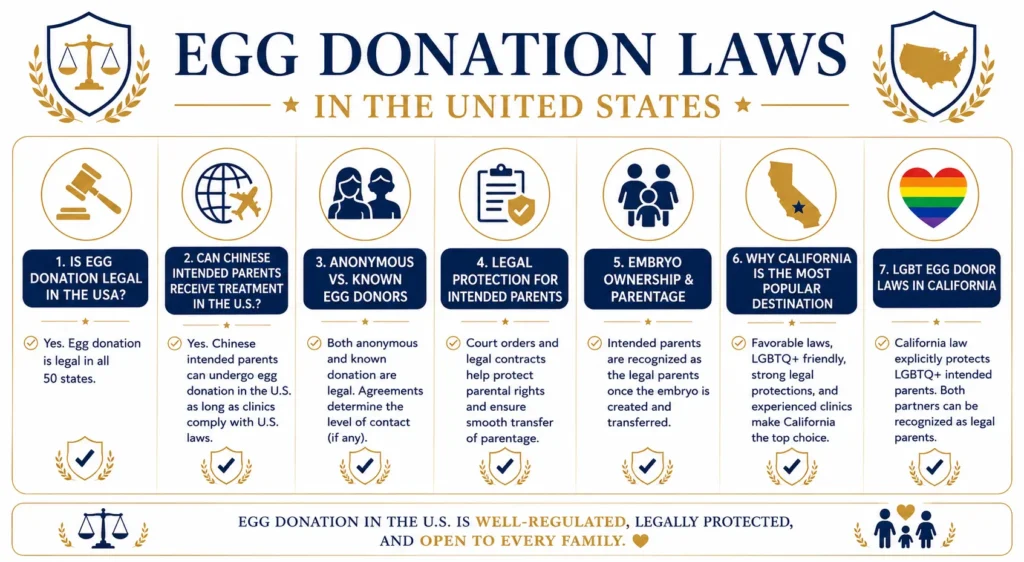
Egg Donation Laws in the United States
Egg donation is a common family-building option for intended parents who cannot achieve pregnancy using their own eggs. The United States is one of the most popular destinations for donor-egg IVF because it offers advanced fertility treatment, diverse egg donor options, and strong legal protections.
However, egg donation laws in the United States vary by state , so intended parents should work with an experienced fertility clinic and reproductive attorney before beginning treatment.
3.1 Is Egg Donation Legal in the USA?
Yes, egg donation is legal in the United States. Both fresh and frozen donor eggs may be used for IVF treatment.
Egg donors may be compensated for their time, effort, and inconvenience. Reputable fertility clinics generally follow ASRM guidelines for donor screening, informed consent, medical safety, and ethical compensation.
Because there is no single federal egg donation law, legal requirements may differ depending on the state where the clinic and donor are located .
3.2 Can Chinese Intended Parents Receive Treatment in the U.S.?
Yes. Chinese Intended Parents can generally travel to United Stares for donor-egg IVF treatment, provided they meet the clinic’s medical requirements and comply with US immigration rules. Many US Fertility clinics work with international patients and may coordinate consultations, donor matching, legal agreements and medical record reviews before intended paretns travel.
Chinese Intended Parents may need:
- A valid passport and US visa
- A fertility-clinic appointment letter
- Medical records with English translations
- P roof of funds for treatment and travel
- Signed egg donation and embryo-storage agreements
3.3 Anonymous vs. Known Egg Donors
US intended parents may choose a non-identified, open-identity, or directed egg donor.
1. Non-identified donor
The donor and intended parents do not exchange identifying information at the time of treatment. However, permanent anonymity cannot be guaranteed because of DNA testing, social media, and online records.
2. Open-identity donor
The donor agrees that identifying information may be released to the donor-conceived child after the child reaches a certain age.
3. Directed or known donor
A friend, relative, or personally selected donor provides the eggs. These arrangements usually require additional legal counseling and psychological evaluation.
The type of donor arrangement does not automatically give the donor parental rights.
3.4 Legal Protection for Intended Parents
Before the donor begins medication, the intended parents and egg donor should sign a legal agreement prepared by reproductive attorneys.
The agreement usually covers:
- The donor’s lack of parental rights
- Intended parents’ rights to the eggs and embryos
- Donor compensation and expenses
- Medical risks and insurance
- Privacy and confidentiality
- Future contact and medical updates
- Cycle cancellation and dispute procedures
The donor and intended parents should have separate legal representation to protect each party’s interests.
3.5 Embryo Ownership and Parentage
The egg donor does not usually own embryos created from donated eggs after the donation is completed under a valid agreement.
Clinic consent forms and legal contracts should explain who controls the embryos and what happens in the event of:
- Divorce or separation
- Death of an intended parent
- Continued embryo storage
- Future embryo transfer
- Donation to another family
- Embryo disposition
Parentage rules may depend on whether the pregnancy is carried by the intended mother or a gestational carrier. International intended parents should also obtain advice about birth certificates, citizenship, passports, and recognition of parentage in their home country.
3.6 Why California Is a Popular Egg Donation Destination
California is one of the most popular destinations for international egg donation and IVF because it has experienced fertility clinics, diverse egg donor databases, reproductive attorneys, and an established legal framework for assisted reproduction.
California is especially popular among Chinese intended parents because many clinics offer multilingual coordination and have extensive experience managing international fertility cases.
However, treatment in California does not automatically resolve immigration, citizenship, or parentage issues in another country. Cross-border legal advice is still important.
3.7 LGBTQ+ Egg Donation Laws in California
California generally allows same-sex couples, single parents, and LGBTQ+ intended parents to access egg donation, IVF, embryo creation, and gestational surrogacy.
Proper legal agreements can help confirm that the egg donor is not a parent and that the intended parents have the intended parental rights.
For male same-sex couples, family building may involve both an egg donor and a gestational carrier. These are separate legal arrangements and should be reviewed by an experienced California reproductive-law attorney.
Related Reading: Gamete and embryo donation guidance
If you’re considering egg donation and have any questions about the process or how your body might respond, feel free to reach out to the【Generation Family Network】 professional team. We’re here to help you understand everything clearly and guide you through each step with confidence and care.
Egg Donation Laws in Taiwan
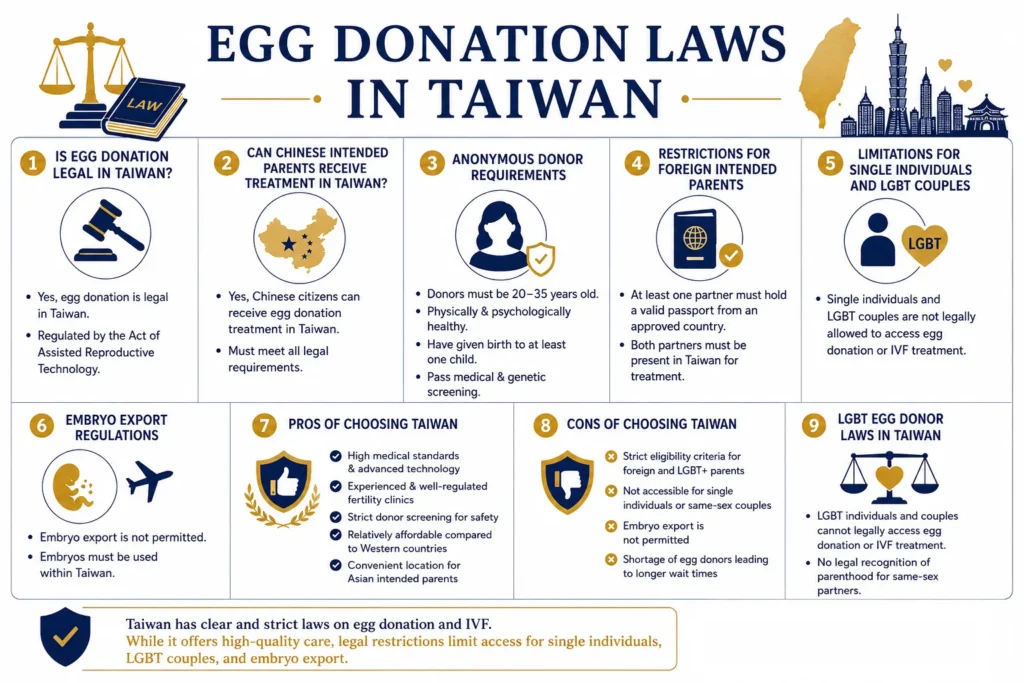
Taiwan is known for high-quality fertility care, experienced IVF specialists, and comparatively affordable treatment. However, egg donation laws in Taiwan are more restrictive than those in the United States, particularly for foreign patients, single individuals, and LGBTQ+ couples.
Under Taiwan’s current Assisted Reproduction Act, donor-egg treatment is generally limited to legally married heterosexual couples who meet specific medical requirements.
4.1 Is Egg Donation Legal in Taiwan?
Yes, egg donation is legal in Taiwan, but it must be performed by an authorized assisted-reproduction institution.
Before treatment, both the recipient couple and donor must complete medical, genetic, infectious-disease, psychological, and family-health assessments. Female egg donors must generally be at least 20 but under 40 years old.
Taiwan requires egg donation to be non-commercial. Donors cannot legally sell their eggs, although intended parents may provide a regulated nutrition allowance and reimburse approved medical, testing, transportation, and lost-income expenses.
4.2 Can Chinese Intended Parents Receive Treatment in Taiwan?
Chinese or other foreign intended parents may potentially receive fertility treatment in Taiwan, but they must meet the same legal eligibility requirements applied by Taiwanese clinics.
Under the current law, assisted reproduction is primarily available to a married husband and wife when one partner has infertility or an approved medical indication. At least one spouse must provide healthy reproductive cells, meaning the couple generally cannot use both donated eggs and donated sperm together.
Mainland Chinese intended parents may also face separate entry, travel-document, medical-payment, and cross-strait administrative requirements. A clinic should confirm eligibility before flights, donor matching, or medication arrangements are finalized.
4.3 Anonymous Donor Requirements
Taiwan follows a legally controlled, non-directed donor system. Intended parents cannot request a specific donor, and donors cannot choose a specific recipient couple.
Clinics may provide limited non-identifying information, including:
- Ethnicity
- Skin color
- Blood type
- Relevant medical information
The donor’s identity is recorded by the clinic and competent authority but is not normally disclosed to the intended parents. Taiwan’s system therefore offers less donor-selection flexibility than many American donor programs.
4.4 Restrictions for Foreign Intended Parents
Foreign nationality alone is not clearly prohibited by the Assisted Reproduction Act, which recognizes passport information in treatment and donor records. However, foreign intended parents must still satisfy Taiwan’s marriage, infertility, consent, and gamete requirements.
Foreign patients should confirm:
- Whether their marriage documents are accepted
- Whether certified Chinese translations are required
- Whether both spouses must attend appointments
- Whether their embryos may legally be transported abroad
- Whether treatment will be recognized in their home country
- Whether they qualify for any financial assistance
Taiwan’s IVF subsidy generally requires at least one spouse to be a Taiwan citizen, so most fully foreign couples should expect to pay treatment expenses privately.
4.5 Limitations for Single Individuals and LGBTQ+ Couples
Under Taiwan’s current Assisted Reproduction Act, treatment is structured around a married husband and wife. As a result, single women, single men, unmarried couples, and same-sex couples generally cannot access donor-assisted reproduction under the existing framework.
This restriction applies even though same-sex marriage is legally recognized in Taiwan. Legal marriage equality does not automatically provide equal access to egg donation, donor sperm, or IVF under the current assisted-reproduction law.
4.6 Embryo Export Regulations
International intended parents should not assume that embryos created in Taiwan can be freely exported to another country.
Taiwanese law regulates the storage, transfer, and destruction of reproductive cells and embryos. It permits certain transfers between authorized assisted-reproduction institutions, but it does not create a simple, automatic patient right to export embryos internationally.
An international transfer may depend on:
- Approval from the Taiwanese clinic
- Requirements of Taiwan’s health authorities
- Donor-consent restrictions
- Cryogenic transportation procedures
- Import rules in the destination country
- Whether the embryos were legally created for the recipients
Before creating embryos in Taiwan for future use overseas, intended parents should obtain written confirmation from the clinic, shipping provider, and reproductive-law professionals in both jurisdictions.
4.7 LGBTQ+ Egg Donor Laws in Taiwan
Under the current law, LGBTQ+ individuals and same-sex couples generally cannot access egg donation or donor-assisted IVF in Taiwan because eligible recipients are defined through a husband-and-wife framework.
A male same-sex couple cannot currently combine an egg donor with a gestational carrier in Taiwan. Surrogacy is also not authorized under the existing Assisted Reproduction Act.
LGBTQ+ intended parents may therefore need to consider jurisdictions such as California, where donor-egg IVF and gestational surrogacy are available to same-sex couples under a more inclusive legal framework.
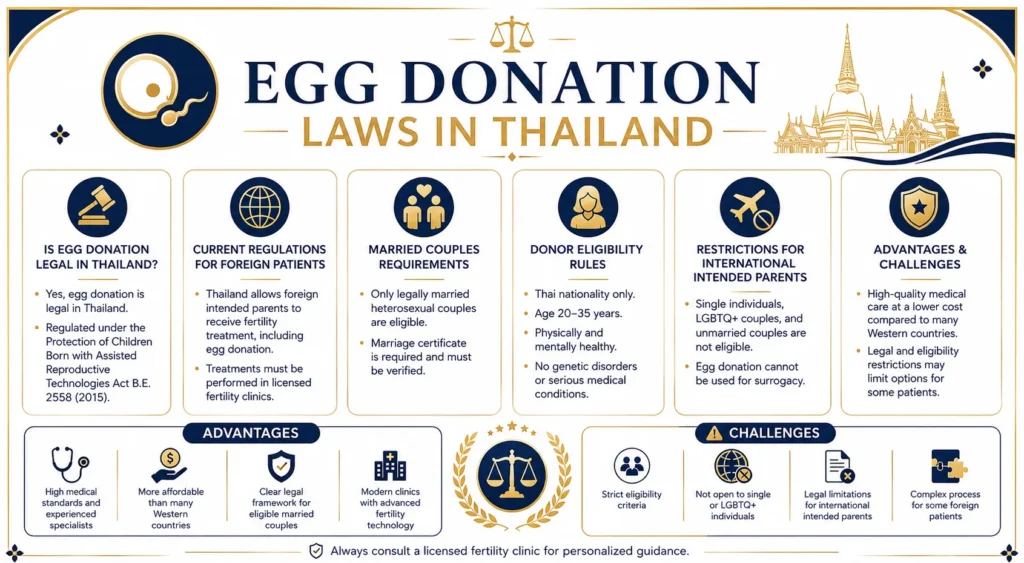
Egg Donation Laws in Thailand
Thailand has become one of Asia’s best-known destinations for fertility treatment because of its modern IVF clinics, experienced reproductive specialists, and comparatively affordable medical costs. However, while IVF is widely available, egg donation laws in Thailand are significantly more restrictive than many intended parents expect. Following major legal reforms, Thailand now has one of the most tightly regulated assisted reproductive technology (ART) systems in Asia, with strict rules governing donor eligibility, commercial compensation, and treatment for foreign patients.
For Chinese intended parents considering Thailand, understanding these legal requirements before beginning treatment is essential. Although egg donation in Thailand remains legal, it is permitted only under specific medical and legal conditions, and many international patients discover that the country’s regulations differ substantially from those in the United States or Taiwan. Questions regarding donor nationality, marital status, embryo transport, and eligibility for foreign couples should all be carefully reviewed before selecting Thailand as a fertility destination.
This section explains the current legal framework for Thailand egg donation for foreign intended parents, including who qualifies for treatment, how donor screening is regulated, restrictions on donor compensation, and the practical advantages and limitations of pursuing IVF with donor eggs in Thailand. If you’re comparing egg donation laws in the USA vs. Taiwan vs. Thailand, this guide will help you determine whether Thailand is the right option for your medical, legal, and family-building goals.
5.1 Is Egg Donation Legal in Thailand?
Yes, egg donation is legal in Thailand when treatment is performed by an appropriately licensed medical professional and complies with Thai assisted-reproduction regulations.
Donor eggs may be used when there is a medical reason, such as poor ovarian reserve, genetic risk, premature ovarian insufficiency, or repeated unsuccessful IVF cycles. Commercial trading in eggs is prohibited, although approved expenses connected with the donation process may be covered.
Because clinic interpretations and documentation requirements can differ, intended parents should confirm their eligibility before selecting a donor or beginning medication.
5.2 Current Regulations for Foreign Patients
Foreign patients may receive fertility treatment in Thailand, but access to donor-assisted IVF is not automatic. Clinics must verify that the treatment complies with Thai law, medical regulations, and professional guidelines.
International intended parents may be required to provide:
- Valid passports
- A legal marriage certificate
- Certified Thai or English translations
- Previous fertility and medical records
- Written consent from both spouses
- Proof of the donor’s medical eligibility
- Additional documents requested by the clinic
Some clinics apply stricter internal policies to international patients because cross-border egg donation, embryo storage, and embryo transportation may involve additional legal risks.
5.3 Married-Couple Requirements
Donor-assisted IVF in Thailand is generally offered to legally married heterosexual couples. Both spouses are usually required to consent to treatment and present evidence of a legally recognized marriage.
Single individuals, unmarried couples, and same-sex couples may not qualify for donor-assisted treatment under the current framework or may be declined under clinic policy.
Marriage documents issued outside Thailand may need to be:
- Notarized or authenticated
- Translated into Thai or English
- Presented in their original form
- Verified by the clinic’s legal or administrative department
International couples should ask the clinic whether both spouses must travel to Thailand for consultation, consent signing, and embryo transfer.
5.4 Donor Eligibility Rules
Egg donors must undergo medical evaluation before being accepted. Screening normally includes ovarian-reserve testing, infectious-disease testing, genetic assessment, psychological evaluation, and review of personal and family medical history.
Depending on the applicable regulations and clinic policy, donors may also need to meet requirements concerning:
- Legal age and reproductive age
- Physical and mental health
- Absence of serious hereditary conditions
- Informed and voluntary consent
- Limits on previous donations
- No prohibited commercial arrangement
- No disqualifying relationship with the intended parents
Donor arrangements in Thailand are generally handled confidentially. Intended parents may receive approved non-identifying information, but access to the donor’s identity and the ability to personally select a donor may be restricted.
5.5 Restrictions for International Intended Parents
Foreign intended parents should not assume that services advertised by an agency are automatically permitted by the treating clinic.
Important restrictions may include:
- Treatment limited to married heterosexual couples
- Verification of foreign marriage documents
- Restrictions on donor identity and direct donor selection
- Prohibition of commercial egg sales
- Clinic approval for embryo storage or transportation
- Import and export requirements for eggs, sperm, or embryos
- Lack of access for single and LGBTQ+ intended parents
- Recognition issues in the intended parents’ home country
Thailand’s 2015 assisted-reproduction legislation was introduced partly to strengthen oversight and prevent commercial or unethical reproductive arrangements.
Intended parents should obtain written confirmation from the clinic before paying agency fees, booking flights, or arranging an international donor cycle.
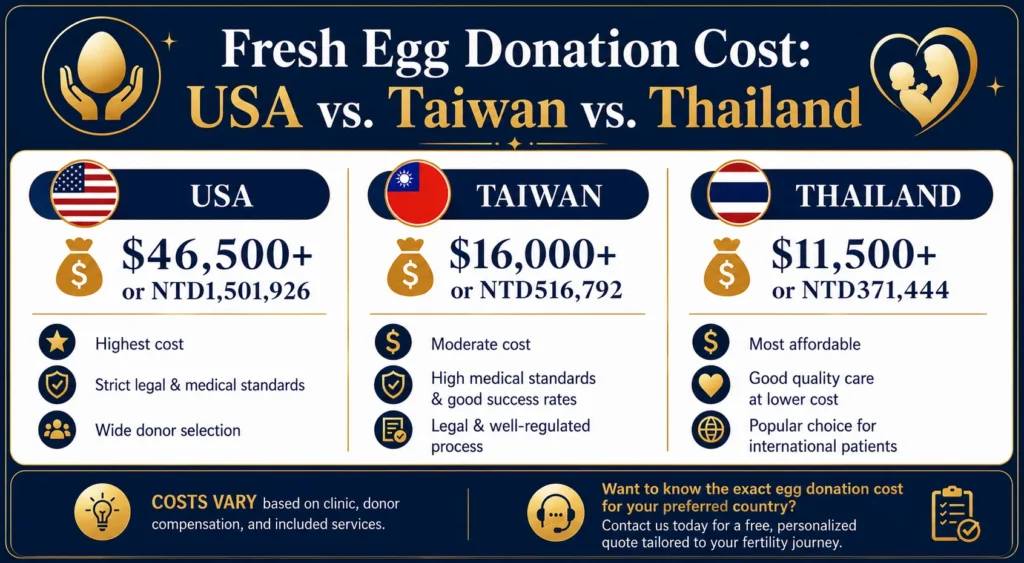
Fresh Egg Donation Cost: USA vs. Taiwan vs. Thailand
One of the biggest considerations for intended parents is the total cost of fresh donor-egg IVF. While treatment in Taiwan and Thailand is generally more affordable than in the United States, the overall value depends on more than the clinic fee. Medication, donor compensation, laboratory services, legal protection, travel, and embryo storage can all significantly affect the final cost.
6.1 Fresh Egg donation cost in the United States
Fresh egg donation in the USA typically starts at USD $46,500+ or NTD 1,501,926, covering donor screening, IVF treatment, agency coordination, legal services, and travel expenses. Final costs vary based on the fertility clinic, donor selection, medications, and personalized treatment plan.
- 💰 Total Cost: Starting at USD $46,500+ or NTD 1,501,926
- 🧬 Pre-Screening, Medical & IVF Fees: USD $35,000–$50,000
- ⚖️ Agency & Legal Fees: USD $8,500+
- ✈️ Travel & Miscellaneous: USD $3,000–$6,000
6.2 Fresh Egg donation Costs in Taiwan
Fresh egg donation in Taiwan starts at USD $16,000+ or NTD 516,792, including donor compensation and IVF treatment. Taiwan is a popular destination for international intended parents, offering high-quality fertility care, experienced IVF specialists, and transparent treatment costs. Final pricing may vary depending on the clinic and treatment plan.
- 💰 Total Cost:USD $16,000+ or NTD 616,792
- 🧬 Includes: Donor compensation, IVF treatment, ovarian stimulation, egg retrieval, and laboratory procedures.
- 📋 Additional Costs: Medications, genetic testing (PGT-A), embryo freezing/storage, and embryo transfer may be charged separately.
6.3 Fresh Egg donation Costs in Thailand
Fresh egg donation in Thailand starts at USD $11,500+ or NTD 371,444, including donor compensation, medical screening, IVF treatment, and travel-related expenses. Thailand is a cost-effective destination for fertility treatment, offering experienced IVF clinics and quality care. Final costs may vary depending on the clinic, donor, medications, and personalized treatment plan.
- 💰 Total Cost: USD $11,500+ or NTD 371,444
- 👩🍼 Donor Compensation: USD $7,000–$10,000
- 🩺 Pre-Screening, Medical, Travel & IVF Fees: USD $4,500–$6,000
6.4 Egg Donor Compensation
Donor compensation varies significantly by country.
- United States: approximately US$10,000+ depending on experience and educational background and qualifications
- Taiwan: regulated nutrition allowance and approved reimbursements rather than commercial compensation.
- Thailand: commercial egg sales are prohibited; donor compensation is regulated under Thai law.
6.5 Medication and Laboratory Costs
Regardless of location, intended parents should budget for additional medical expenses.
These commonly include:
- Fertility medications
- Blood tests and ultrasound monitoring
- Egg retrieval
- ICSI (if required)
- Embryo culture
- Embryo freezing
- PGT-A/PGT-M genetic testing
- Annual embryo storage
- Medication alone may cost US$3,500–7,000 in the United States, while laboratory and medication fees are generally lower in Taiwan and Thailand.
6.6 Legal and Escrow Fees
Legal expenses are often overlooked but can be significant, particularly in the United States.
Potential costs include:
- Reproductive attorney fees
- Egg donor agreements
- Escrow management
- Insuance for donor complications
- Contract review
Legal fees are generally highest in the U.S., while Taiwan and Thailand usually involve lower legal costs due to their more regulated donor programs.
6.7 Which Country Offers Better Overall Value?
Each destination offers different advantages depending on your priorities.
- United States: Best for donor choice, legal protection, LGBTQ+ family building, and international flexibility—but also the highest overall cost.
- Taiwan: Excellent value for eligible married heterosexual couples seeking high-quality IVF at a lower price.
- Thailand: Competitive pricing and modern fertility clinics, but legal eligibility is more restrictive for international intended parents.
When comparing countries, consider not only the clinic’s advertised IVF price but also donor availability, legal protections, success rates, medication, travel expenses, and long-term family-building goals.

Frequently Ask Questions
Q1: Can Chinese citizens legally receive egg donation treatment in the USA?
A1: Yes. Chinese citizens may generally receive donor-egg IVF treatment in the United States if they meet the fertility clinic’s medical and financial requirements and are legally admitted to the country.
Medical treatment is a permitted purpose for a U.S. visitor visa or, where applicable, the Visa Waiver Program. However, treatment approval does not guarantee visa issuance or entry at the border.
Q2: Is egg donation legal in Taiwan for foreigners?
A2: Egg donation is legal in Taiwan, and the law records passport information for foreign patients and donors. However, foreign intended parents must still meet Taiwan’s eligibility requirements.
Under the current Assisted Reproduction Act, recipients must generally be a married husband and wife, have an approved medical reason for treatment, and have at least one spouse with healthy reproductive cells. Clinics may also require authenticated marriage documents and translations.
Q3: Can embryos be transported internationally?
A3: International embryo transportation may be possible, but it is not automatic. Approval depends on the laws of both countries, the policies of the sending and receiving clinics, donor consent, import or export permits, and cryogenic shipping requirements.
Taiwan permits certain transfers between licensed assisted-reproduction institutions, but its law does not provide an unrestricted right to export embryos internationally. Intended parents should obtain written approval before creating embryos intended for overseas use.
Q4: Is anonymous egg donation available in all three countries?
A4: Not under the same system.
United States: Non-identified, open-identity, and known-donor arrangements may be available, depending on the program.
Taiwan: Donation is non-directed. Intended parents cannot request a specific donor and normally receive only limited non-identifying information.
Thailand: Anonymous donation may be available through some regulated programs, but clinic policies and legal requirements should be confirmed before treatment.
In Taiwan, clinics may disclose information such as ethnicity, skin color, and blood type, but must withhold the donor’s identifying medical-record information from the recipient couple.
Q5: Which destination offers the strongest legal protection?
A5: For most international intended parents, the United States—especially California—generally offers the strongest and most customizable legal framework.
The United States commonly uses independent reproductive attorneys, detailed donor agreements, escrow arrangements, and written provisions concerning donor non-parentage, embryo control, compensation, confidentiality, and future contact.
Taiwan and Thailand provide regulated medical systems, but they impose stricter eligibility and donor-selection rules. Cross-border embryo transportation and recognition in the intended parents’ home country may also be more complicated.
For Chinese intended parents prioritizing legal security, flexibility, and donor choice, the United States is generally the strongest option.
Why Choose Generation Family Network?
Choosing an egg donor is a deeply personal decision. Generation Family Network supports intended parents throughout the entire process—from donor selection and medical coordination to legal guidance, travel planning, and cycle management.
Our goal is to make international egg donation more organized, transparent, and supportive for Chinese intended parents.
8.1 Access to Highly Educated Asian Egg Donors
Generation Family Network provides access to a diverse selection of Asian egg donors, including Chinese, Taiwanese, Korean, Japanese, Southeast Asian, and mixed-heritage candidates.
Depending on availability, donor profiles may include:
- Education and occupation
- Physical characteristics
- Personality and interests
- Family medical history
- Previous egg retrieval results
- Genetic and fertility screening
- Photos and introduction videos
We help intended parents review suitable candidates based on their family-building priorities rather than simply choosing a donor based on appearance.
8.2 International Legal and Medical Coordination/b>
Cross-border egg donation may involve fertility clinics, donor agencies, laboratories, attorneys, insurance providers, and international travel arrangements.
Our team helps coordinate communication between the intended parents and the professionals involved in the cycle, including:
- Fertility clinics
- Medical coordinators
- Reproductive attorneys
- Genetic-screening providers
- Donor insurance companies
- Travel and accommodation providers
We also help intended parents understand important requirements related to treatment eligibility, donor screening, cycle timelines, embryo storage, and international transportation.
8.3 Secure Escrow Protection
Financial transparency is an important part of every egg donation journey.
Where applicable, intended-parent funds may be managed through an independent escrow provider. Payments are released according to agreed contractual milestones rather than being transferred directly without oversight.
Escrow protection can help provide:
- Clear payment schedules
- Transparent fund management
- Documented expense releases
- Greater financial security
- Reduced risk for intended parents and donors
The exact escrow structure depends on the destination, clinic, legal agreement, and services selected.
8.4 Personalized Matching for Chinese Intended Parents
Every family has different preferences, medical needs, timelines, and budgets. Our matching process is personalized rather than one-size-fits-all.
We help Chinese intended parents consider factors such as:
- Donor ethnicity and family background
- Education and personal characteristics
- Previous donation experience
- Egg retrieval history
- Genetic-screening results
- Treatment destination
- Donor availability
- Budget and legal requirements
Once intended parents select their initial preferred donors, we can provide additional available information and help coordinate the next steps.
8.5 Schedule a Free Consultation
Starting an international egg donation journey can feel overwhelming, but you do not have to manage every step alone.
Schedule a free consultation with Generation Family Network to discuss:
- Your preferred treatment country
- Egg donor availability
- Estimated costs
- Medical and legal requirements
- Treatment timelines
- International travel considerations
Our team will help you understand your available options and create a clearer path toward building your family.
💬 Message Generation Family Network today for personalized guidance and answers to your fertility questions. We’re here to support you every step of your family-building journey.
If you’re considering egg donation and have any questions about the process or how your body might respond, feel free to reach out to the【Generation Family Network】 professional team. We’re here to help you understand everything clearly and guide you through each step with confidence and care.